Paper
A design canvas built on real HTML/CSS that stays connected to your codebase, your data, and AI coding agents.
🔗 Visit Paper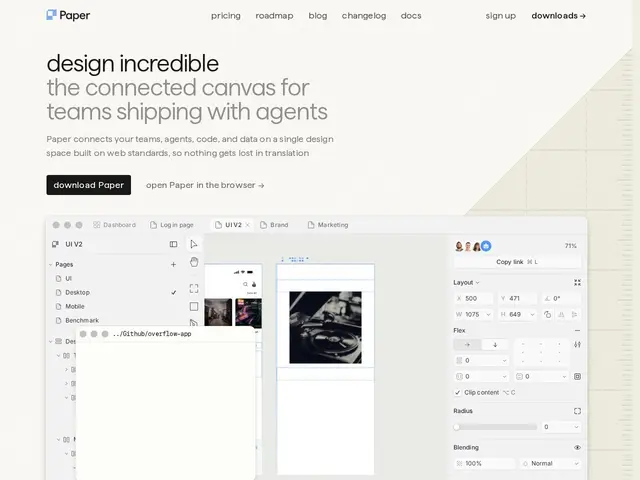
Description
Design tools and the actual product code usually live in two separate worlds: you design in one app, then a developer rebuilds everything by hand in another. Paper tries to remove that translation step by making the canvas itself speak the same language as the product — real HTML and CSS — so what you draw can sync directly with a codebase instead of being redrawn from scratch.
Concretely, Paper is a web and desktop canvas where design tokens sync bidirectionally with your code, components can pull live data from apps, databases or APIs, and an integrated Model Context Protocol (MCP) server lets AI coding agents (Cursor, Claude Code and similar) read from and write to the same canvas — generating responsive layouts or style variations on request. It supports collaborative commenting and threading like a typical design tool, but exports cleanly to code rather than to static assets. It's aimed at product teams — especially ones already leaning on AI coding agents — who want design and implementation to stop drifting apart.
💬 Our review
The short version: Paper's bet — a canvas built on actual web standards instead of a proprietary format, wired into MCP so agents can act on it directly — is a genuinely different angle on the design/dev divide, and the $34M Series A (Accel, ICONIQ, July 2026) suggests real traction.
The honest alternative is Figma, which remains far more mature, has a vastly larger plugin and template ecosystem, and is the default your whole industry already speaks — Paper's HTML/CSS foundation and agent integration are the differentiators, not raw feature parity. The free plan's 100 weekly MCP calls will get exhausted fast if you're actually using agents daily, pushing serious users to the $20/month (or $16/month yearly) Pro tier quickly. Worth it if your team is already building with AI coding agents and tired of hand-translating Figma files into components; less compelling if you're not touching MCP-based workflows yet.
💰 Pricing
📊 Global score
🤖 AI-enriched data
Gratuit : postes illimités, 100 appels MCP/semaine. Pro : 20 $/mois (16 $/mois en annuel), 1M d'appels MCP/semaine. Organisations : tarif sur devis.
Pros
Canevas basé sur du vrai HTML/CSS, pas un format propriétaire
Synchronisation bidirectionnelle des design tokens avec le code
Serveur MCP intégré pour les agents de code IA
Levée de 34M$ (Accel, ICONIQ, juillet 2026) — traction réelle
Cons
Écosystème de plugins/templates bien plus restreint que Figma
100 appels MCP/semaine gratuits s'épuisent vite en usage agentique quotidien
Moins pertinent si l'équipe n'utilise pas encore de workflows MCP
Produit encore jeune face à un standard industrie établi