Wayfern
Browser infrastructure for web scraping at scale — thousands of concurrent sessions with fingerprints that pass major bot-detection tests, so you don't have to build and maintain anti-detect infrastructure yourself.
🔗 Visit Wayfern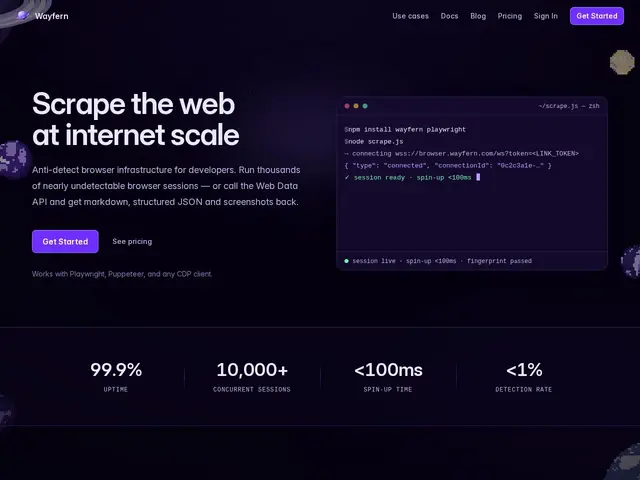
Description
Scraping a handful of pages by hand is trivial; scraping reliably at scale is a different problem entirely, because sites like Amazon, LinkedIn or Cloudflare-protected pages actively try to detect and block automated browsers. Building your own infrastructure to beat that detection — consistent fingerprints, proxy rotation, session management — is a real engineering project on its own, separate from whatever data you actually wanted to collect. Wayfern's pitch is to be that infrastructure layer, so developers can focus on the scraping logic instead of the arms race against bot detection.
Wayfern runs browser sessions with fingerprints designed to pass major detection tests, supporting up to 10,000 concurrent sessions with sub-100ms spin-up, built-in bypass for Cloudflare, DataDome and PerimeterX, and a CDP-compatible endpoint that works with Playwright, Puppeteer or any Chrome DevTools Protocol client. It also ships pre-built scrapers for major sites (Amazon, Google, LinkedIn, TikTok, Instagram, Walmart, Zillow, eBay, Indeed, Yelp) and a Search API that normalizes results across Google, Bing and DuckDuckGo. Pricing runs on a unified credit system: Developer $19/month (20 concurrent sessions), Business $99/month (100 sessions), Scale $499/month (400 sessions), plus custom Enterprise and non-expiring credit packs starting at $12.50 for 1,000 credits.
💬 Our review
The short version: Wayfern is squarely in a well-established but genuinely useful category — anti-detect browser infrastructure — and the pre-built scrapers for specific high-value targets (Amazon, LinkedIn, TikTok) save real setup time versus building detection-bypass logic per site yourself.
Against Bright Data or Oxylabs, the established enterprise players in this space, Wayfern's entry price ($19/month for 20 concurrent sessions) is dramatically more accessible for a solo developer or small startup testing a scraping-dependent product, though the bigger names have longer track records and larger proxy pools for the hardest targets. The category itself carries an unavoidable caveat worth stating plainly: scraping sites like LinkedIn or Amazon at scale usually violates those platforms' terms of service, even when technically undetectable, so the legal and ethical risk sits with whoever runs the scrape, not the infrastructure provider. Good fit for a developer building a product that legitimately needs structured web data at scale and has already thought through the compliance question; not a shortcut around a site's terms of service just because it's technically possible.
💰 Pricing
📊 Global score
🤖 AI-enriched data
Developer : 19 $/mois (20 sessions). Business : 99 $/mois (100 sessions). Scale : 499 $/mois (400 sessions). Enterprise sur devis. Packs de crédits non expirants dès 12,50 $.
Pros
Jusqu'à 10 000 sessions concurrentes, spin-up sous 100ms
Contournement intégré de Cloudflare/DataDome/PerimeterX
Scrapers prêts à l'emploi pour Amazon, LinkedIn, TikTok
Prix d'entrée accessible (19 $/mois)
Cons
Pools de proxies moindres que Bright Data/Oxylabs
Le scraping à grande échelle enfreint souvent les CGU ciblées
Système de crédits complexifie la comparaison
Peu d'infos publiques sur financement/ancienneté