Maple
An open-source observability platform — traces, logs, metrics and browser session replay in one tool, built on OpenTelemetry so you're not locked into a proprietary agent.
🔗 Visit Maple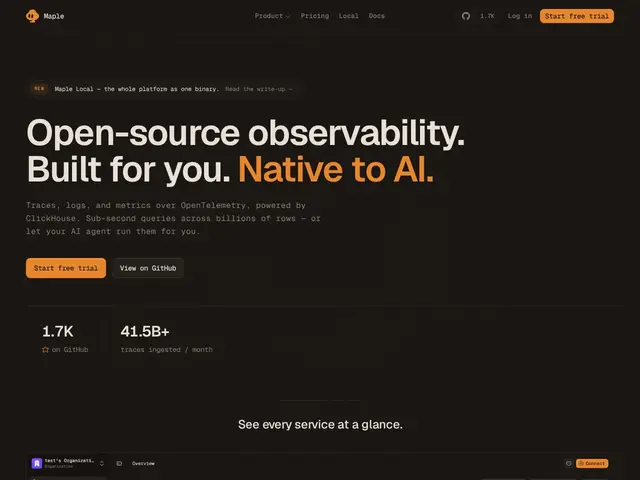
Description
Most observability tools want you to install their proprietary agent, format your data their way, and then charge per host or per seat once you're locked in. Maple takes a different starting point: it's built entirely on OpenTelemetry, the open industry standard, so if your services already emit OpenTelemetry data, you point it at Maple and it just works — no re-instrumenting, no vendor-specific SDK.
Maple covers distributed tracing, full-text log search, metrics and custom dashboards, a service catalog with dependency mapping, error tracking and alerting, Kubernetes monitoring, and browser session replay, plus AI-powered diagnostics exposed through an MCP server so coding agents can search traces and propose fixes directly. It's self-hostable (source available on GitHub, 1.7k stars, under the Functional Source License which converts to Apache 2.0 after two years) or usable as a managed service. Pricing is usage-based rather than per-seat: a Startup plan at $39/month includes 100GB of logs/traces/metrics plus 5k browser sessions, with Enterprise starting around $2,000/month; a 14-day free trial is available.
💬 Our review
The short version: Maple's real bet is that OpenTelemetry-native, no-lock-in observability plus usage-based pricing beats the traditional per-host/per-seat model that makes tools like Datadog or New Relic expensive to scale, and building on ClickHouse for the storage layer is a proven technical choice for high-cardinality telemetry data at speed.
Against Grafana's OSS stack (Loki/Tempo/Mimir) — the other major open, OTel-friendly option — Maple's advantage is a single unified app instead of stitching together three separate projects, though Grafana's ecosystem is far more mature and has a much larger community for troubleshooting edge cases. The Functional Source License is worth reading carefully: it's not fully open source until the two-year conversion to Apache 2.0, so a competitor can't immediately fork and resell it, but you also don't get unrestricted OSI-approved freedom on day one. Solid pick for an engineering team that already emits OpenTelemetry data and wants one dashboard instead of three, especially if usage-based pricing beats their current per-host bill; teams deeply invested in Grafana's ecosystem already may not find enough reason to switch.
💰 Pricing
📊 Global score
🤖 AI-enriched data
Startup : 39 $/mois (100 Go de logs/traces/métriques inclus, 0,30 $/Go au-delà). Enterprise : à partir de ~2000 $/mois. Essai gratuit 14 jours.
Pros
Natif OpenTelemetry, aucun agent propriétaire ni ré-instrumentation nécessaire
Traces, logs, métriques et session replay dans une seule appli
Auto-hébergeable (1,7k stars GitHub), tarification à l'usage plutôt qu'au siège
Diagnostics IA exposés via MCP pour les agents de code
Cons
Licence FSL, pas open source complet avant 2 ans
Écosystème moins mature que la stack Grafana
Enterprise démarre à ~2000 $/mois
Pas de financement/traction publique au-delà des 1,7k stars