DockPanel
A free, open-source server control panel that runs your sites, databases, Docker apps, DNS, mail and backups from one dashboard — shipped as a single binary that uses about 49MB of RAM.
🔗 Visit DockPanel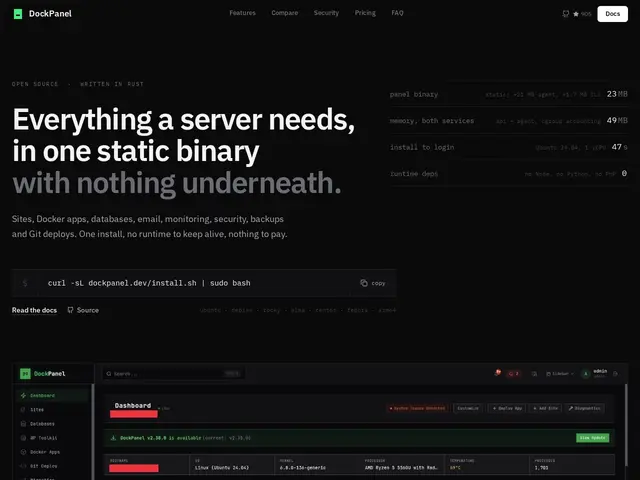
Description
Running your own server usually means either paying for a managed hosting panel (cPanel, Plesk) that costs real money per month, or gluing together a pile of separate tools yourself — one for Docker, one for DNS, one for backups — with no shared dashboard. DockPanel is a free alternative built for people who want cPanel's convenience without the subscription: install one binary on your own server and get sites, databases, Docker apps, DNS, a full mail stack and automated backups managed from a single web dashboard.
DockPanel is written in Rust (Axum backend) with a React 19 frontend and a bundled PostgreSQL 16 database, distributed as a single static binary with a curl-based installer and zero external dependencies. It supports Git-based deploy with Nixpacks, blue-green zero-downtime updates and automatic rollback on failed health checks, Cloudflare and PowerDNS integration, a Postfix/Dovecot/DKIM/Rspamd mail stack, and 148 one-click app templates across 14 categories. It's licensed AGPL-3.0, has 905 GitHub stars, runs on Ubuntu 20+, Debian 11+, CentOS 9+, Rocky 9+, AlmaLinux 9+ and Fedora 39+, and idles at roughly 49MB RAM for the panel (about 109MB including the bundled database).
💬 Our review
The short version: DockPanel's actual differentiator against Coolify or CapRover (the more established open-source self-hosting panels) is breadth combined with a genuinely tiny resource footprint — most panels this feature-complete (mail server, DNS, Docker, Git deploy, backups) cost you noticeably more RAM than 49MB, which matters a lot on a $5/month VPS.
Written in Rust rather than the PHP or Node stacks most competing panels use is a real technical choice, not just a marketing detail — it explains both the low memory footprint and the single-binary distribution with no dependency hell to manage. Against cPanel specifically, DockPanel is free and self-hosted versus cPanel's per-server licensing cost, but it's also much younger (905 GitHub stars, no long enterprise track record) and AGPL-3.0 licensing means any modified, network-exposed fork technically has to publish its source — worth knowing if you plan to white-label it commercially. Solid pick for a developer or small team self-hosting on a budget VPS who wants cPanel-like convenience without the license fee; an agency managing dozens of client servers with strict uptime SLAs may still prefer the longer track record of Coolify or a paid managed panel.
💰 Pricing
📊 Global score
🤖 AI-enriched data
100% gratuit et open source (AGPL-3.0), auto-hébergé sur votre propre serveur.
Pros
Empreinte mémoire minime (~49 Mo) pour un panel aussi complet
Écrit en Rust, binaire unique, zéro dépendance externe
Couvre sites, bases de données, Docker, DNS, mail ET sauvegardes
Gratuit et open source, déploiement Git avec rollback automatique
Cons
Jeune projet (905 stars), pas d'historique entreprise long terme
Licence AGPL-3.0 : version modifiée exposée en réseau doit republier son code
Moins mature que Coolify/CapRover sur le terrain
Distributions Linux supportées limitées aux versions récentes