TinyFish
Enterprise web infrastructure for AI agents — search, fetch, and browser automation APIs used by Google, DoorDash, and other large companies.
🔗 Visit TinyFish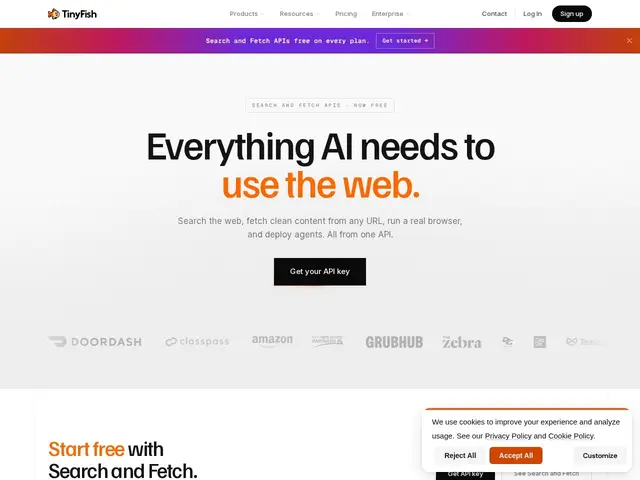
Description
An AI agent that needs to browse a website, fill out a form, or pull data from a page most people can't do that reliably — pages block bots, layouts change, and logins get in the way. TinyFish builds the plumbing so agents can actually navigate the web the way a person would.
TinyFish is a web infrastructure platform for AI agents, offering four APIs: Search (real browser-rendered web search returning structured JSON), Fetch (converts pages to clean markdown/JSON/HTML), Agent (multi-step web automation including form-filling and authenticated flows), and Browser (cloud-hosted browser sessions with stealth anti-bot capabilities). The company has raised $47 million and counts Google, DoorDash, ClassPass, Amazon, and Grubhub among its users, running hundreds of thousands of agents monthly.
💬 Our review
The short version: TinyFish is solid, proven infrastructure if you're building AI agents that need reliable web interaction at real scale — but it's built and priced for companies with production workloads, not a weekend side project.
Against Selenium, Playwright, or Browserless — general browser-automation tools you self-host and maintain — TinyFish's pitch is managed reliability at scale: stealth browser profiles that bypass anti-bot protection, a claimed 89.9% accuracy on industry benchmarks, and enterprise customers like Google and DoorDash already running hundreds of thousands of agents through it monthly. That's a different tier of proof than most competitors in this space can show. The free Search and Fetch APIs are a genuinely low-risk way to try it before committing to the paid Agent ($0.016/step) and Browser ($0.002/minute) tiers. The trade-off is that pay-per-use pricing can add up fast at real agent volume, and the whole product is enterprise-oriented — an indie developer building a small side project will find Playwright or Apify cheaper and simpler for light use. Best fit: teams building production AI agents that need reliable, anti-bot-resistant web access at scale. Weaker fit: hobbyists or small side projects where a free, self-hosted tool like Playwright is more cost-effective.
💰 Pricing
📊 Global score
🤖 AI-enriched data
Search et Fetch APIs gratuites. Agent API : 0,016 $/étape. Browser API : 0,002 $/minute. 8 $ de crédits offerts aux nouveaux comptes. Pas d'abonnement ni d'engagement minimum.
Pros
89,9% de précision sur benchmarks du secteur
APIs Search et Fetch gratuites
Intégration MCP avec Claude et autres outils IA
Profils navigateur furtifs contournant l'anti-bot
Adoption entreprise prouvée (Google, DoorDash...)
Cons
Coûts pay-per-use pouvant s'accumuler à l'échelle
Gestion de clé API et de portefeuille requise
Limité à l'automatisation web (pas d'apps desktop)
Tarification orientée entreprise, moins adaptée aux devs indie