Checksum AI
AI testing platform that generates, runs, and self-heals end-to-end tests as real Playwright code on every pull request.
🔗 Visit Checksum AI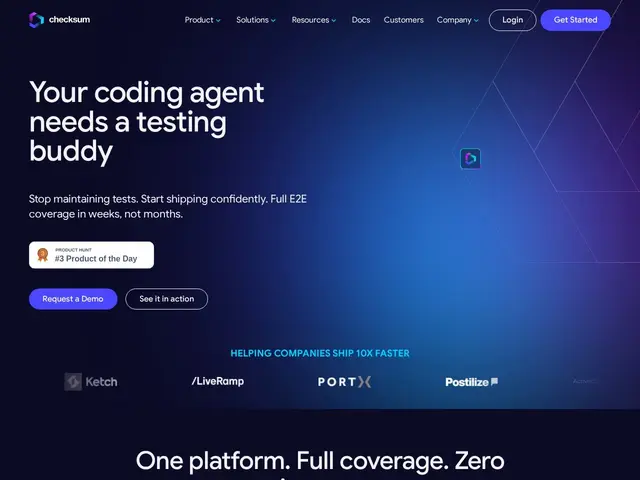
Description
When a coding agent changes your app faster than a human can keep up, your test suite becomes the thing that either catches real bugs or drowns you in false failures from tests that just went stale. Checksum AI tries to keep the test suite moving at the same speed as the code.
Checksum AI is an AI-native continuous testing platform that automatically generates, runs, and self-heals end-to-end, API, and unit tests, producing 50-200 production-ready Playwright tests per pull request as standard code committed to your own repository. When a test fails, it distinguishes between a real bug and a stale test, and autonomously fixes roughly 70% of the false failures caused by legitimate interface changes. It integrates directly with AI coding agents like Claude Code and Cursor via slash commands, and holds SOC 2 and ISO 27001 certifications.
💬 Our review
The short version: Checksum AI addresses a real, growing pain point — test suites that can't keep up with AI-assisted development — and the self-healing claim (70% of broken tests fixed automatically) is a genuinely useful number if it holds up in practice; the catch is pricing is entirely hidden behind a sales conversation.
Against Cypress, Sauce Labs, or Katalon, which are testing platforms you configure and maintain yourself, Checksum's pitch is that the AI writes and maintains the tests for you, generating real Playwright code that lives in your repo rather than a black-box test format you're locked into. That 'own the code' detail matters — you're not trapped in a proprietary format if you ever want to migrate away. The self-healing feature is the standout: automatically distinguishing a real regression from a test that broke because the UI legitimately changed is exactly the kind of judgment call that eats engineering time otherwise. The lack of public pricing is the main friction — 'Results as a Service' billed by workflow count sounds reasonable in principle, but you can't budget for it without a sales call, which rules it out for smaller teams doing quick evaluations. Best fit: engineering teams shipping fast with AI coding agents who need test coverage that keeps pace without manual maintenance. Weaker fit: small teams or solo developers wanting to self-serve pricing and start immediately without a sales conversation.
💰 Pricing
📊 Global score
🤖 AI-enriched data
Facturation basée sur le nombre de workflows/tests maintenus, pas au siège ni à l'exécution. Aucune grille tarifaire publique — contact commercial requis.
Pros
Génération autonome de tests à l'échelle (jusqu'à 200/24h)
Auto-réparation ~70% des tests cassés
Intégration CI/CD profonde, à chaque commit
Gère des applications complexes à milliers d'endpoints
Certifications entreprise (SOC 2, ISO 27001)
Cons
Limité à Playwright pour la génération de tests
Tarification opaque, contact commercial obligatoire
Nécessite une intégration CI/CD existante
70% d'auto-réparation implique 30% encore manuels