Vessel
Lets a SaaS company offer "connect your CRM" or "connect your Slack" buttons to its own customers without building and maintaining 100+ separate integrations in-house.
🔗 Visit Vessel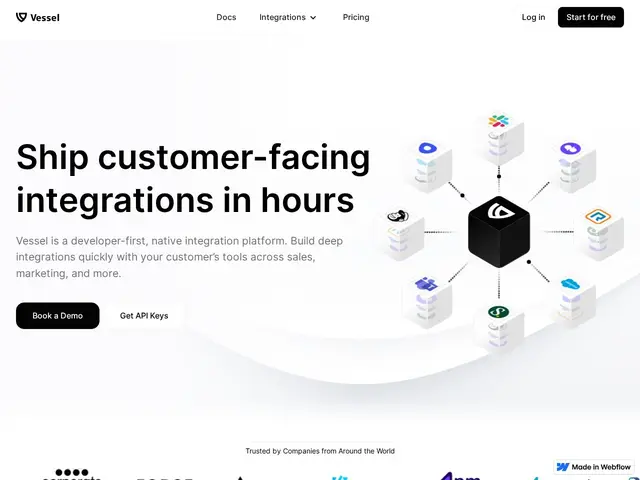
Description
If you run a SaaS product and your customers keep asking "can this connect to my CRM/Slack/dialer," building and maintaining each of those integrations yourself is a slow, ongoing tax on your engineering team. Vessel exists to let you offer that connectivity to your own customers without building it all from scratch.
Vessel is a developer-first native-integration platform that lets companies ship customer-facing integrations in hours instead of months. It provides pre-built connectors and a unified API to 100+ business applications across CRM, sales engagement, chat, marketing automation, and dialer categories, along with typed SDKs, real-time webhooks, and managed data pipelines. It's SOC 2 certified and offers fine-grained permissions, aimed at engineering teams who need to embed integrations into their own product rather than build a general internal automation.
💬 Our review
The short version: if your product roadmap keeps getting blocked by "we need to build an integration with X," Vessel's pre-built connector library is worth evaluating against building that integration in-house — the free Start tier makes it cheap to test on a handful of connections first.
Vessel's positioning is narrower and more developer-facing than Zapier or Make, which target end users automating their own workflows across any app. Vessel instead targets engineering teams embedding integrations into their own SaaS product for their customers — closer to what a company like Merge or Apideck does. Its specific focus on GTM-stack apps (CRM, sales engagement, dialers, marketing automation) rather than a fully general integration catalog is both a strength (deeper coverage in that niche) and a limit (you're out of luck if you need, say, accounting or e-commerce integrations). The free Start tier (unlimited API calls, 5 dev connections) is generous for evaluation, but Launch and Custom tier pricing isn't public, which makes it hard to budget without a sales call. Best fit: SaaS companies building customer-facing GTM integrations who don't want to maintain 100+ API integrations themselves. Weaker fit: teams needing integrations outside the sales/marketing/CRM category, or anyone wanting transparent self-serve pricing beyond the free tier.
💰 Pricing
📊 Global score
🤖 AI-enriched data
Start (gratuit) : appels API illimités, 5 connexions de développement. Launch : tarif personnalisé, jusqu'à 20 connexions. Custom : sur devis, marque blanche, connexions illimitées.
Pros
Plus de 100 connecteurs prêts à l'emploi
API unifiée avec SDK typés
Certifié SOC 2, permissions fines
Webhooks temps réel et pipelines de données gérés
Cons
Tarifs Launch/Custom non publics
Portée limitée aux intégrations GTM (CRM, ventes, marketing)
Petite équipe qui peut limiter la vitesse de support