Metorial
A security control layer that lets AI agents safely use your company's tools — Stripe, Slack, Salesforce, and 1000+ others — without giving them free rein over sensitive systems.
🔗 Visit Metorial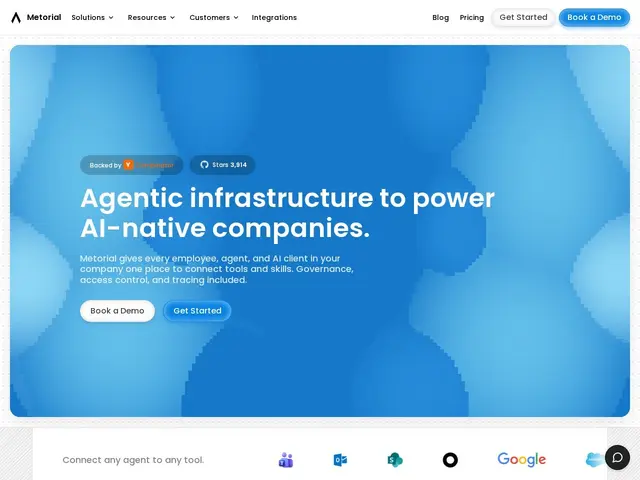
Description
Giving an AI agent access to your CRM or payment system is useful, but also a little terrifying — what stops it from doing something you didn't intend? Metorial exists to answer that question: it sits between AI agents and your actual business tools, deciding what they're allowed to touch and logging everything they do.
Metorial is an agentic infrastructure platform acting as a control plane for AI agents that need to access 1,000+ integrations (Stripe, Slack, Notion, Salesforce, internal systems) via the Model Context Protocol (MCP). It provides Protoguard, a layer designed to block prompt-injection attacks, along with SSO/SAML identity management, role-based access control, reusable "skills" that teams can share, and complete audit trails for compliance. It's open source, with an active GitHub community (~3,300 stars), and works with any MCP-compatible agent, including Claude, Codex, Cursor, and Copilot.
💬 Our review
The short version: if your team is moving AI agents from toy demos into production systems that touch real customer data or money, Metorial's governance layer — permissions, audit logs, injection protection — is the kind of infrastructure you'll wish you had before an agent does something you didn't authorize, not after.
Metorial competes less with general automation tools like Zapier or Make and more with the emerging category of "MCP gateways" — it's specifically built for agent-to-tool access via the Model Context Protocol, which is a narrower and newer standard than generic workflow automation. Its differentiators are security-first: Protoguard against prompt injection, SSO/SAML, and RBAC are the kind of controls enterprise security teams actually ask for before approving agent deployments, and being open source (3,300+ stars) means the access-control logic can be audited rather than trusted blindly. The free Dev tier (500K tool calls, 10 integrations) is generous for prototyping, but the jump to Scale at $250/month is a real commitment, and overage at $1 per 1,500 calls can add up fast for a high-traffic agent. Best fit: teams already running MCP-compatible agents (Claude, Cursor, Copilot) in production who need governance, not just connectivity. Weaker fit: teams still exploring AI agents casually — the security tooling here is overkill until you actually have something worth protecting.
💰 Pricing
📊 Global score
🤖 AI-enriched data
Dev : gratuit, 500K appels d'outils, 2 membres, 10 intégrations. Scale : 250 $/mois, 2,5M appels, 20 membres, intégrations illimitées. Enterprise : sur devis. Dépassement : environ 1 $/1 500 appels.
Pros
Open source, plus de 3 300 étoiles GitHub
Compatible avec tout agent MCP (Claude, Codex, Cursor, Copilot)
Sécurité poussée : Protoguard, RBAC, SSO/SAML, logs d'audit
Plus de 1 000 intégrations prêtes à l'emploi
Cons
Palier Scale à 250 $/mois peut exclure les petites équipes
Limité aux agents compatibles MCP
Coûts de dépassement qui s'accumulent vite