Heybounce
Checks a list of email addresses before you send to them, so you catch the fake, dead, and spam-trap addresses that would otherwise hurt your sender reputation and land your emails in spam.
🔗 Visit Heybounce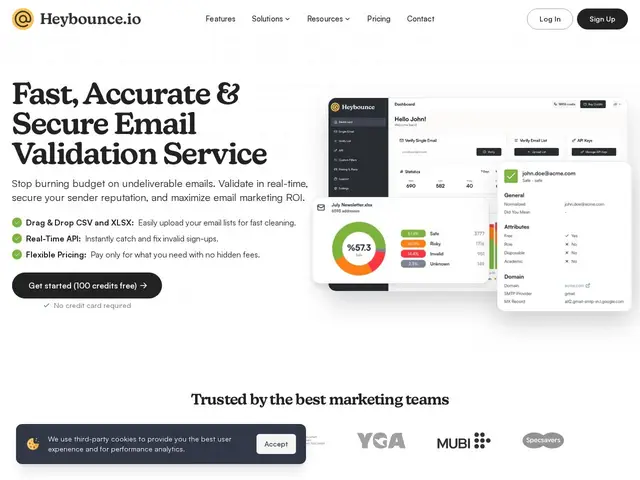
Description
Sending an email campaign to a list full of dead or fake addresses doesn't just waste the send — it can flag your domain as spammy with mail providers, hurting deliverability for every future email you send. Heybounce checks a list before you send it, so the damage never happens.
Heybounce is a real-time email verification and validation service that detects invalid addresses, disposable emails, spam traps, and role-based addresses (like info@ or admin@) before you send to them. It works via drag-and-drop bulk upload for existing lists or a real-time API for validating addresses as they're collected, aiming to improve email campaign deliverability and protect sender reputation at scale.
💬 Our review
The short version: if you send email campaigns and have never run your list through a verifier, Heybounce's free 100 credits are enough to see how many bad addresses are quietly hurting your deliverability before you pay anything.
Against established players like ZeroBounce and NeverBounce, Heybounce's pitch is straightforward: comparable detection (disposable emails, spam traps, role-based addresses) at competitive per-credit pricing, with an API response time around 73ms. Being founded in 2023 means it's newer and less battle-tested than competitors with a decade-plus track record, and it doesn't currently offer a self-hosted or open-source option for teams wanting to keep verification in-house. The credits-never-expire model and not charging for "unknown" results are genuinely fair pricing choices — some competitors quietly charge for ambiguous results. Best fit: marketing teams and agencies running regular campaigns who want straightforward, fairly-priced list hygiene without commitment. Weaker fit: enterprises needing a verification vendor with a long compliance track record and dedicated account management — ZeroBounce's longer history may matter more there.
💰 Pricing
📊 Global score
🤖 AI-enriched data
Gratuit : 100 crédits, sans carte bancaire. Packs : 1 000 crédits pour 8 $ jusqu'à 1 000 000 pour 2 200 $. Abonnement mensuel à 30 $ pour 5 000 crédits (10% de réduction). Paiement à l'usage à 0,006 $/email vérifié. Résultats "inconnu" non facturés. Crédits sans expiration.
Pros
API temps réel, environ 73ms de réponse moyenne
Taux de délivrabilité revendiqué de 99,4%
Détecte emails jetables, spam traps, adresses génériques
Résultats "inconnu" non facturés, crédits sans expiration
Cons
Fondé en 2023, moins éprouvé que les concurrents historiques
Pas d'option auto-hébergée ou open source
Peu de détails publics sur la conformité au-delà du RGPD/CCPA