Airpinpoint
A dashboard that lets a business track hundreds or thousands of Apple AirTags at once — something Apple's own Find My app was never built to handle, since it caps you at 32 tags per account.
🔗 Visit Airpinpoint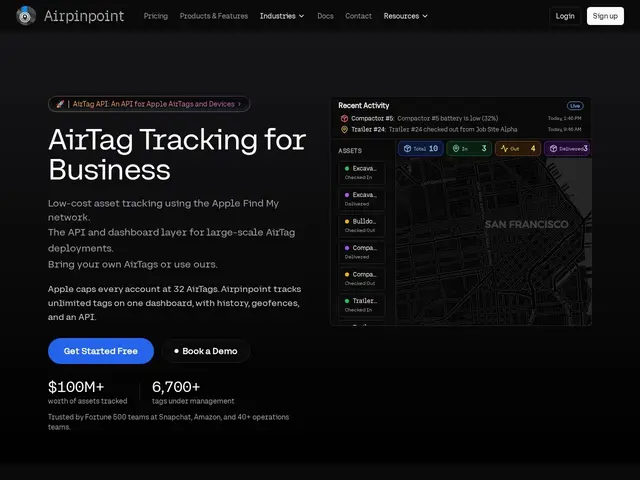
Description
Apple's AirTags are cheap and reliable trackers, but Apple's own app was designed for a person tracking their keys and luggage, not a company tracking a fleet of equipment — it hard-caps you at 32 tags per account. Airpinpoint exists to remove that ceiling so businesses can actually use AirTags at scale.
Airpinpoint is an enterprise asset-tracking platform that lets businesses track unlimited Apple AirTags from a single dashboard. It provides real-time location tracking, geofencing with alerts, location history with data export, and API/webhook/Zapier integrations with over 7,000 apps. It's built on Apple's Find My network rather than cellular GPS, which keeps hardware costs and battery life dramatically better than typical GPS trackers, at the cost of relying on Apple's crowd-sourced Bluetooth network for location updates.
💬 Our review
The short version: if you're tracking dozens or hundreds of pieces of equipment and have hit Apple's 32-tag account limit, Airpinpoint's per-tag pricing is worth comparing against a traditional GPS tracker before you assume you need cellular GPS.
Airpinpoint's real differentiator against GPS-based fleet trackers like Geotab or Samsara is the underlying technology: it rides on Apple's Find My Bluetooth network instead of cellular GPS, which is why its trackers claim 7+ year battery life versus the 1-3 week to 3-year lifespans typical of GPS units, and why it can be roughly 75% cheaper per unit. The trade-off is real: Find My relies on nearby Apple devices to relay location, so it works less reliably in remote areas with low iPhone density, and there's no live continuous GPS breadcrumb trail — you get Apple's crowd-sourced pings, not a moving-map view. At $11.99-14.99 per tag per month, the ongoing subscription cost adds up for large fleets even though the hardware itself is cheap. Best fit: businesses tracking assets that mostly stay in populated, Apple-device-dense areas — warehouses, job sites, retail equipment, delivery routes in cities. Weaker fit: fleets operating in remote or rural areas where GPS-based tracking with continuous cellular connectivity is more reliable.
💰 Pricing
📊 Global score
🤖 AI-enriched data
Business : 11,99 $/tag/mois (mises à jour 1 min, alertes de livraison, géorepérage). Enterprise : 14,99 $/tag/mois (webhooks, liens partageables 1 an, export CSV/Excel). Matériel : 18-22 $/tag à partir de 50 unités, ou AirTags existants. Remises volume à partir de 100 tags.
Pros
Tags illimités sur un seul dashboard vs la limite de 32 d'Apple
Batterie de plus de 7 ans sur les balises propriétaires
Environ 75% moins cher qu'un tracker GPS classique
API, webhooks et plus de 7 000 intégrations via Zapier
Cons
Dépend du réseau Find My d'Apple, moins fiable en zone peu dense
Pas de suivi GPS continu type carte en temps réel
Coût par tag qui grimpe vite sur de grandes flottes