Swytchcode
A safety layer that sits between an AI coding agent and the real APIs it calls, checking that responses look right and blocking calls the agent shouldn't be allowed to make.
🔗 Visit Swytchcode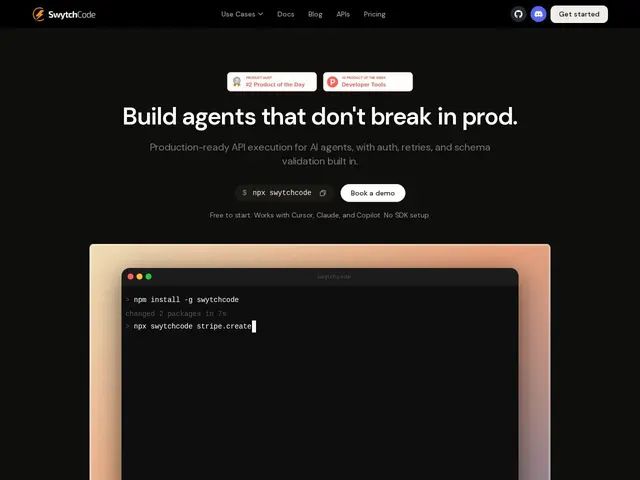
Description
When you let an AI agent call real APIs on its own — placing orders, updating records, hitting third-party services — the scary part isn't that it might fail, it's that it might succeed at doing the wrong thing, or silently break when an API changes shape. Swytchcode sits in that gap: it checks every API call an agent makes against what's actually expected, and stops the ones that look wrong before they cause damage.
Swytchcode is API execution middleware built specifically for AI agents (used with tools like Cursor, Claude, and Copilot), installed with a single CLI command and no SDK required. It validates schemas to catch API drift, validates responses to confirm calls actually succeeded, enforces policy with allowlists and dry-run modes, and logs a full audit trail of what an agent did and when — adding under 50ms of latency in the process.
💬 Our review
The short version: if you're already letting an AI agent make real API calls in production, Swytchcode is cheap insurance — the free tier (1,000 calls/month) is enough to test whether the schema-drift protection catches something a bare integration would have missed.
Its niche is specific: general API tools like Postman or Stoplight are built for humans designing and testing APIs by hand, not for policing what an autonomous agent does at runtime. Swytchcode's audit trail, dry-run mode, and allowlist enforcement are the pieces that matter once an agent — not a person — is the one making the call. The trade-off is that it's a narrow, single-purpose safety layer: it doesn't help you build or document the API itself, only govern how agents use it. At $29/month for 5,000 calls, it scales awkwardly if your agent traffic is high-volume, since Enterprise pricing is custom and unpublished. Best fit: teams already running AI agents against real, consequential APIs (payments, CRM writes, infra changes) who need a policy and audit layer. Weaker fit: someone just prototyping an agent against a sandbox API with no real-world consequences yet.
💰 Pricing
📊 Global score
🤖 AI-enriched data
Gratuit (1 000 appels/mois). Pro 29 $/mois (5 000 appels/mois). Enterprise sur devis (illimité).
Pros
Installation en une commande CLI, aucun SDK requis
Détecte les changements de schéma API (drift) avant qu'ils cassent l'agent
Politique d'accès avec allowlist et mode dry-run
Piste d'audit complète des appels effectués par l'agent
Overhead de latence minime (moins de 50 ms)
Cons
Outil mono-fonction : ne conçoit ni ne documente l'API elle-même
29 $/mois pour seulement 5 000 appels — coûte cher à fort volume
Tarif Enterprise non public
Utile seulement si l'agent fait déjà de vrais appels à conséquences réelles