SampleApp.ai
Turns your API into a guided, interactive sandbox with real generated code, so new developers can try it and integrate it in minutes instead of reading a wall of docs first.
🔗 Visit SampleApp.ai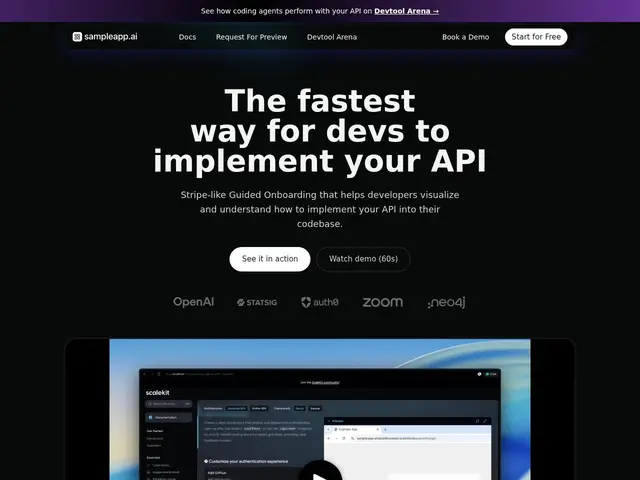
Description
The usual way to learn an API is to read a reference page, copy a curl example, and hope it works in your own project's language and framework. SampleApp.ai skips that translation step: it walks a developer through your API step by step, generating working code in their actual tech stack as they go, with a live preview running right there in the browser.
SampleApp.ai is a platform for API providers and developer relations (DevRel) teams that turns static documentation into a guided, interactive onboarding flow. It generates personalized code for multiple stacks (React, FastAPI, Flask, Express, and more), offers pre-built flows for common use cases, and tracks a dashboard of where developers drop off during onboarding. It plugs into existing docs platforms like Docusaurus, Mintlify, ReadMe, and GitBook rather than replacing them, and syncs engagement data to HubSpot or Salesforce for teams that want to follow up with prospects who got stuck.
💬 Our review
The short version: if your team already has API docs but keeps hearing that new developers bounce before their first successful call, SampleApp.ai's guided, code-generating sandbox targets exactly that drop-off point — worth trialling if you can quantify how many signups never make it to a working integration.
Its differentiator against a reference-first tool like ReadMe or Stoplight is that those are still primarily documentation with an embedded API console, while SampleApp.ai's whole product is the guided, hand-holding onboarding flow itself, generating code in the visitor's own stack rather than a single canonical example. The analytics dashboard showing exactly where developers drop off is genuinely useful for a DevRel team trying to prioritize what to fix. The catch: pricing isn't public, so budgeting requires a sales conversation, and since it integrates alongside your existing docs platform rather than replacing it, you're paying for an additional tool layered on top rather than a full substitute. Best fit: API providers and DevRel teams with real drop-off data showing developers stall during onboarding. Weaker fit: an early-stage API with too few users yet to justify a dedicated onboarding layer — good docs in ReadMe or Mintlify alone may be enough for now.
💰 Pricing
📊 Global score
🤖 AI-enriched data
Tarif non public — contact commercial nécessaire.
Pros
Génération de code personnalisé selon la stack du développeur (React, FastAPI, Flask, Express…)
Parcours guidé étape par étape avec aperçu de code synchronisé
Tableau de bord d'analytics sur les points d'abandon lors de l'onboarding
S'intègre à des plateformes de docs existantes (Docusaurus, Mintlify, ReadMe, GitBook)
Cons
Tarif non public, appel commercial obligatoire
Vient en complément d'une doc existante, pas un remplacement complet
Utile surtout si le volume de développeurs justifie d'optimiser l'onboarding
Pas d'essai gratuit visible publiquement