StackAI
A no-code, drag-and-drop platform for building AI agents that enterprises in regulated industries can actually get approved for internal use.
🔗 Visit StackAI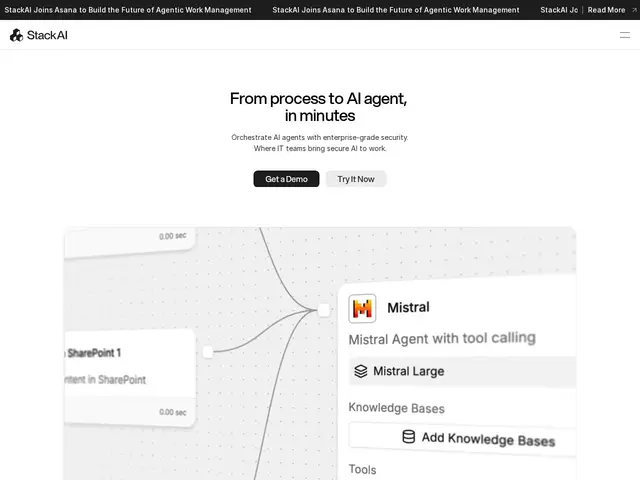
Description
Most companies that want to use AI internally run into the same wall: someone in IT or legal needs to sign off on where the data goes, who can see it, and what happens if the AI gets something wrong. StackAI is built specifically to get past that wall — it's a way to build AI-powered tools (chatbots, document processors, approval workflows) by dragging and connecting blocks on a canvas, without writing code, while keeping the security and audit trail that a bank or hospital's compliance team will actually ask for.
StackAI is a no-code platform for building and deploying AI agents at enterprise scale. Users assemble workflows visually — connecting LLMs, data sources, and logic steps — and can insert human-in-the-loop checkpoints so a person approves sensitive actions before they execute. It's LLM-agnostic (swap between model providers without rebuilding the workflow) and supports multi-tenant, VPC, or fully on-premise deployment, which matters for healthcare, financial services, and legal customers who can't send data to a shared cloud. Built-in audit logs, governance controls, and 100+ integrations round it out, with access via a REST API or a Slack bot for teams that just want a chat interface.
💬 Our review
The short version: if your company's blocker on shipping AI internally is compliance and deployment control rather than the AI itself, StackAI's on-premise/VPC options and audit trail are the actual product — the no-code builder is table stakes at this point.
The no-code AI-agent-builder space is crowded (n8n, Zapier, Make, Retool all now have AI nodes), and StackAI doesn't try to out-feature them on integrations. Its real differentiator is deployment flexibility for regulated environments: multi-tenant, VPC, or fully on-premise, with governance and audit logs built in rather than bolted on. That's a genuine advantage for a hospital system or bank that can't use a cloud-only tool no matter how good it is. The free tier (500 runs/month, 2 projects) is honestly just a trial — anyone serious about deploying this will land on custom Enterprise pricing, and StackAI doesn't publish a number, so budgeting requires a sales call. Best fit: enterprise teams in healthcare, finance, or legal that need a governed, on-prem-capable AI builder. Weaker fit: a small team that just wants the cheapest way to wire an LLM into a spreadsheet — Zapier or Make will get there faster and cheaper.
💰 Pricing
📊 Global score
🤖 AI-enriched data
Gratuit : 500 runs/mois, 2 projets. Enterprise : tarif sur devis, projets illimités, infrastructure dédiée (VPC/on-premise).
Pros
Déploiement flexible : multi-tenant, VPC ou 100% on-premise — rare dans ce segment
Gouvernance et logs d'audit natifs, pas ajoutés après coup
Agnostique au modèle LLM, étapes de validation humaine intégrables
100+ intégrations prêtes à l'emploi
Cons
Tarif Enterprise non public — nécessite un appel commercial pour tout usage sérieux
Le tier gratuit (500 runs/mois) est surtout un essai, pas un usage réel
Face à des concurrents comme n8n ou Make sur la simple automatisation, pas d'avantage prix
Positionnement clairement entreprise — peu pertinent pour un usage solo ou petite équipe