Datatera.ai
Feed it a messy pile of PDFs, invoices or web pages and Datatera.ai turns them into clean, structured spreadsheet or CRM records — with an audit trail so a finance or legal team can trust where each number came from.
🔗 Visit Datatera.ai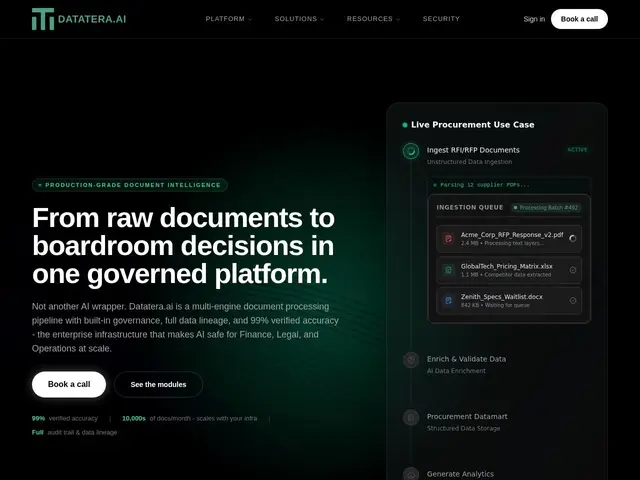
Description
A lot of business data still lives in a form computers can't easily use — scanned invoices, contracts, web pages, emails — and turning that into something a spreadsheet or CRM can actually work with usually means someone typing it in by hand or a fragile custom script. Datatera.ai is built to automate that conversion without either of those, using AI to read the document and extract the right fields into structured data, with governance controls attached so a regulated team can trust the result.
Datatera.ai runs unstructured documents and websites through a multi-engine AI processing pipeline to produce structured, governed business intelligence — the company advertises 99% verified accuracy along with enterprise-grade data lineage and audit trails, aimed squarely at finance, legal and operations teams that need to prove where a number came from, not just get the number. It started life closer to a lightweight Chrome-extension tool for converting a single page or file into a spreadsheet, and has since repositioned as a more enterprise-focused data platform, founded in 2021 and based in Barcelona and San Francisco. Pricing is tiered by document volume (Starter up to 2,000 docs/month, Growth up to 10,000, Enterprise beyond that), all quote-based, with no free trial but pilots available for evaluation.
💬 Our review
The short version: Datatera.ai is a reasonable option for a finance, legal or ops team that needs document-to-data conversion with an audit trail attached, but the lack of a free trial and public pricing means you should push for a real pilot before signing anything.
It sits in the same general space as tools like Import.io, Octoparse and Apify for turning unstructured sources into structured data, but its pitch is narrower and more enterprise: not just extraction, but governance and lineage a regulated team can point to when asked "where did this number come from." That's a genuine differentiator if you're in finance or legal ops specifically, and a non-issue if you just need bulk web scraping — in which case Apify or Octoparse are cheaper and more general-purpose. The claimed 99% verified accuracy is worth testing on your own messiest documents during the pilot rather than taking at face value, since accuracy claims in document-AI extraction vary a lot with document quality. No free trial and no public pricing means procurement will take longer than a self-serve tool — factor that into your timeline. Best fit: finance/legal/ops teams processing meaningful volumes of unstructured documents who need governance, not just extraction. Weaker fit: a solo user who just wants to convert one webpage to a spreadsheet occasionally — a free browser extension will do that job.
💰 Pricing
📊 Global score
🤖 AI-enriched data
Starter (jusqu'à 2 000 documents/mois), Growth (jusqu'à 10 000/mois), Enterprise (10 000+/mois) — tous sur devis. Pas d'essai gratuit, pilotes disponibles pour évaluation.
Pros
Gouvernance et traçabilité (lineage) intégrées — pas juste de l'extraction brute
Pipeline multi-moteurs annoncé à 99% de précision vérifiée
Positionnement clair pour des cas d'usage réglementés (finance, juridique)
Pilotes disponibles pour tester avant d'engager un contrat
Cons
Pas d'essai gratuit ni de tarification publique — processus d'achat plus long qu'un outil self-service
Chiffre de précision à 99% à vérifier sur ses propres documents les plus complexes
Overkill pour un simple besoin ponctuel de conversion page-vers-tableur
Marché de l'extraction de données déjà occupé par des acteurs établis (Apify, Octoparse)