DepthData
A company's AI tool bill is easy to see; whether that spend is actually being used is not. DepthData pulls usage and cost data from every AI vendor into one dashboard so finance can tell the difference.
🔗 Visit DepthData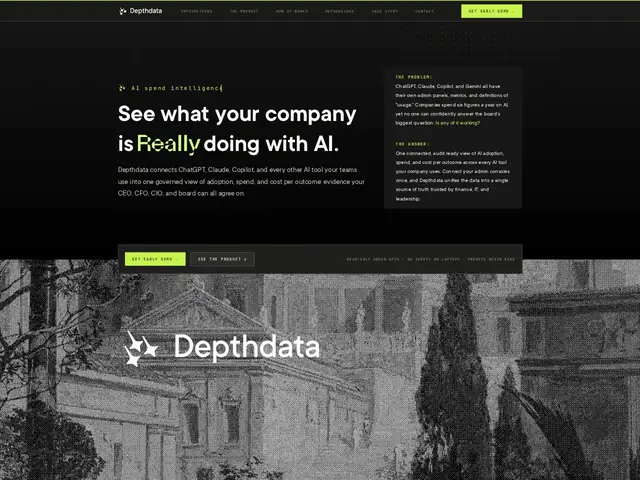
Description
A mid-size company today might pay for ChatGPT Enterprise, Claude, GitHub Copilot and a handful of other AI subscriptions across different teams, with no single view of who's actually using what. Finance sees one growing line item after another and no easy way to tell whether that spend is translating into real usage or a pile of unused seats. DepthData is built specifically to answer that question.
DepthData connects to the admin/usage APIs of AI vendors — ChatGPT, Claude, Copilot, Gemini, and others — and consolidates adoption metrics, cost-per-active-user, and idle-seat counts into a single, audit-ready dashboard for finance and IT teams. Each figure is labeled by how it was verified, and the vendor connections are read-only: it never reads prompts or conversation content, only account-level usage and billing metadata that each vendor's API exposes. It's an early-stage, indie-built product currently in early access with demo-based onboarding, so pricing isn't public yet and the vendor-coverage breadth should be checked against your specific AI stack before committing.
💬 Our review
The short version: DepthData is solving a real and growing problem — AI tool sprawl with no spend visibility — but it's early enough that you should confirm it actually supports every vendor you use before trusting it as your source of truth.
There isn't yet an established, well-known competitor doing exactly this (AI-specific spend/adoption auditing, as opposed to general SaaS spend management tools like Vendr, Zylo or Torii, which track software spend broadly but weren't built around AI vendor usage nuances specifically). That makes DepthData interesting as a category-first mover, but also means it hasn't been battle-tested at scale the way a general SaaS-management platform has. Because it's in early access with demo-based onboarding and no public pricing, budget-conscious teams should treat this as a pilot, not a guaranteed vendor: talk to them directly, confirm coverage of your actual AI stack, and get a real quote before assuming it replaces manual auditing. Best fit: mid-size to large companies with AI spend scattered across multiple teams and vendors who need a finance-grade audit trail. Weaker fit: a small team with one or two AI subscriptions, where a shared spreadsheet still does the job just fine.
💰 Pricing
📊 Global score
🤖 AI-enriched data
Pas de grille tarifaire publique — produit en early access avec onboarding sur demande (démo)
Pros
Répond à un problème réel et grandissant : dépense IA éparpillée sans visibilité d'usage
Connexions en lecture seule, ne lit jamais le contenu des prompts/conversations
Chaque chiffre est étiqueté selon sa méthode de vérification — traçabilité pour un audit
Positionnement de premier arrivant sur l'audit de dépense IA spécifiquement (vs SaaS générique)
Cons
Produit en early access, pas encore éprouvé à grande échelle
Aucune grille tarifaire publique — il faut passer par une démo pour connaître le prix
Couverture exacte des fournisseurs IA à vérifier avant de se fier au chiffre final
Overkill pour une petite équipe avec un ou deux abonnements IA seulement