Dreambase
Point your Postgres or Supabase database at Dreambase and it builds the dashboards, reports and answers a data analyst would — no warehouse, no SQL, no waiting.
🔗 Visit Dreambase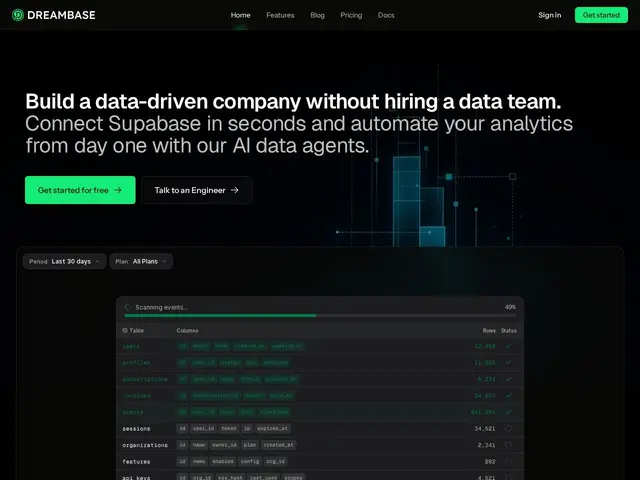
Description
If you run a product on Supabase or plain Postgres, you already have all the data you need to answer questions like "how many users came back this week" or "which plan churns the most" — the problem is turning raw tables into an actual chart without hiring someone who knows SQL or wiring up a separate analytics stack. Dreambase is built to close that gap: it connects to your existing database with read-only credentials, figures out on its own what your tables and columns mean, and lets you ask for a report in plain English instead of writing queries by hand.
Dreambase is an AI-native analytics layer that sits directly on top of Postgres or Supabase — no ETL job, no data warehouse, no tracking SDK to install. Once connected, its AI agents map your schema automatically, infer what your events and entities represent, and can generate dashboards, anomaly alerts and ad-hoc answers in seconds rather than the hours or days a manual BI setup usually takes. Supabase itself is invested in the company and lists it as an official analytics partner, which is a reasonable trust signal given how directly Dreambase touches production data. Pricing runs free (1 user, 1 dashboard, 1 schema) up to Pro at $29-49/month, Team at $249/month (annual only), and custom Enterprise, with a 14-day trial on paid tiers.
💬 Our review
The short version: if your analytics need is "I have a Supabase/Postgres database and I want charts without SQL," Dreambase does exactly that and does it fast — but it's solving a narrower problem than general-purpose BI tools, so check the fit before paying.
Against Metabase, the obvious free/open-source alternative, Dreambase's pitch is setup time: Metabase still requires you to model your data and build dashboards by hand, while Dreambase's AI agents do the schema mapping and dashboard generation for you — a real advantage if you don't have a data person on staff. Against Basedash, a close AI-native BI competitor connecting to 600+ sources, Dreambase is deliberately narrower: it's Postgres/Supabase-only, which is a limitation if you also pull data from Stripe or Salesforce, but it means deeper, more reliable schema understanding for the one database type it supports. The free tier is real enough to test on a side project, but at 1 dashboard and 1 schema it's a demo, not a working setup — budget for Pro ($29/mo annual) once you're past prototyping. Best fit: indie developers and small SaaS teams already on Supabase who want product analytics without adding a second data stack. Worse fit: teams with data spread across many non-Postgres sources, where a broader tool like Basedash or a real warehouse setup will serve better long-term.
💰 Pricing
📊 Global score
🤖 AI-enriched data
Free : 1 utilisateur, 1 dashboard, 1 schéma, support communautaire Slack. Pro : 29 $/mois (annuel) ou 49 $/mois (mensuel), 3 utilisateurs, 5 dashboards. Team : 249 $/mois (annuel uniquement), 5 utilisateurs, 15 dashboards. Enterprise sur devis. Essai gratuit 14 jours sur les plans payants.
Pros
Connexion directe à Postgres/Supabase sans ETL ni entrepôt de données à monter
Mapping automatique du schéma par IA — pas besoin d'écrire de SQL
Supabase est investisseur et partenaire officiel, gage de sérieux technique
Essai gratuit 14 jours sur les plans payants, tier gratuit réel pour tester
Cons
Limité à Postgres/Supabase — inutile si vos données sont chez Stripe, Salesforce, etc.
Tier gratuit très restreint (1 dashboard, 1 schéma) : bon pour tester, pas pour un usage réel
Plan Team à 249 $/mois disponible uniquement en facturation annuelle
Produit jeune, pas d'historique long terme sur la fiabilité à grande échelle