Omphalis
An AI reading app that cleans up and structures articles, PDFs, podcasts and videos into a navigable, annotatable format with cross-content connections, free for ~8 sources/month or paid tiers up to 50GB storage.
🔗 Visit Omphalis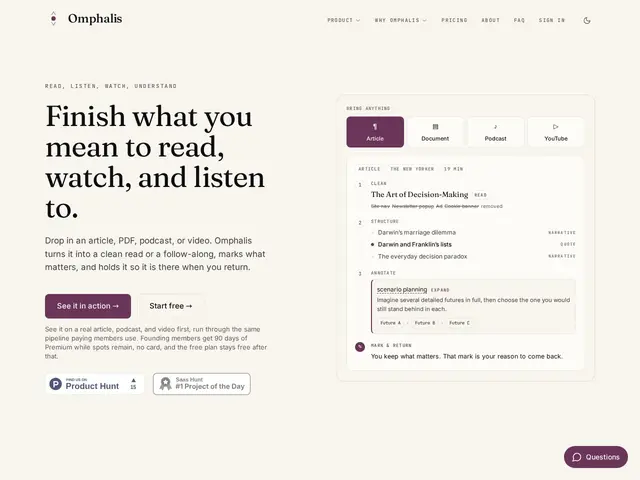
Description
Reading a dense research paper, a long article and listening to a podcast all feel like separate activities that live in separate apps, with no way to connect an idea from one to another. Omphalis tries to turn all of them into one searchable personal library instead.
Omphalis ingests articles, PDFs, EPUBs, Word documents, podcasts, videos and voice notes, strips out clutter, maps the structure of the argument (opening, turn, dense section, practical implication), and lets you highlight, annotate and save return points across all of it. Its "Ask & Find" feature searches your library with source attribution, a memory layer tracks what you've actually understood over time, and text-to-speech reads content aloud. It's built by Voxiven LLC, has a browser extension for Chrome and Firefox, and explicitly promises to never charge for reading your own writing, your own notes, exporting data, or account access — only the AI processing, TTS and cloud storage are paid. Free tier: ~8 articles/month, 2GB storage; Pro: ~60 articles/month, 25GB; Premium: unlimited sources, 50GB.
💬 Our review
The short version: a genuinely thoughtful reading tool if you regularly work through long-form content across formats (papers, podcasts, videos) and want to actually retain it, not just collect it — the explicit promise to never charge for your own data or exports is a real trust signal in a space full of read-it-later apps that quietly shut down (like Pocket).
What sets Omphalis apart from a simple read-it-later app like the departed Pocket, or a highlighting tool like Readwise Reader, is the structural mapping (identifying the argument's turn, dense sections, practical implications) and the cross-content connections between an article, a PDF and a podcast on the same topic — that's closer to what NotebookLM does for a curated set of sources, but built specifically around personal reading habits rather than a research workspace. The free tier's 8 articles/month is genuinely limiting if you read a lot; you'll likely need Pro fairly quickly. Best fit: researchers, writers and heavy readers who consume long-form content across text, audio and video and want it organized in one place; skip it if you just need simple bookmarking, where a free tool is enough.
💰 Pricing
📊 Global score
🤖 AI-enriched data
Gratuit : ~8 articles/mois, 2 Go de stockage. Pro : ~60 articles/mois, 25 Go. Premium : sources illimitées, 50 Go. Montants exacts en dollars non affichés publiquement.
Pros
Promesse explicite de ne jamais facturer la lecture de son propre contenu, ses notes ou l'export de données
Cartographie structurelle du contenu (ouverture, tournant, section dense) au-delà du simple surlignage
Connecte des idées entre articles, PDF et podcasts sur un même sujet
Cons
Palier gratuit limité à environ 8 articles/mois, vite insuffisant pour un gros lecteur
Montants exacts en dollars des paliers payants non publiés sur le site
Produit jeune (2026), moins de recul que Readwise Reader