Modelfy 3D
Upload a photo, get back a 3D model you can drop into a game engine or send to a 3D printer — no 3D modeling software or sculpting skill required.
🔗 Visit Modelfy 3D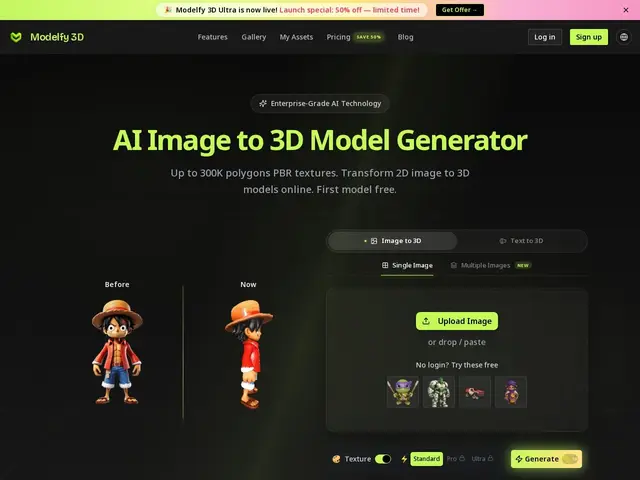
Description
Turning a flat photo into a usable 3D object normally means either learning 3D modeling software (a real skill investment) or paying a 3D artist by the piece. Modelfy 3D automates that conversion: upload a 2D image (JPG, PNG, WEBP), and it generates a 3D model with real geometry — up to 300,000 polygons and photorealistic PBR textures — exported in the formats game engines, 3D printers, and web viewers actually accept (GLB, OBJ, STL).
It runs on a credit-based freemium model with four quality tiers (Fast at 15K polygons up to Ultra at 300K), so a hobbyist testing an idea and a studio needing production-grade assets can both fit somewhere on the pricing ladder. It's aimed at game developers, product designers, e-commerce teams needing 3D product views, and VR developers — anyone who needs a 3D asset fast and doesn't have (or want to hire) a 3D artist for every one-off piece.
💬 Our review
The short version: if you have a 2D image and need a usable 3D model without learning Blender or hiring someone, this does exactly that job well — the four quality tiers mean you're not stuck paying Ultra-tier prices for a quick prototype.
The main thing to watch is credit consumption at scale: the entry paid tier (Pro, $9.90/month) includes 1,000 credits, but if you're generating in bulk — say, product photos for an entire e-commerce catalog — you'll want to check how many credits each polygon tier actually burns before committing, since that determines real cost-per-model far more than the sticker price. Compared to hiring a freelance 3D artist per asset (often $50-200+ per model), this is dramatically cheaper for anything that doesn't need hand-sculpted precision.
💰 Pricing
📊 Global score
🤖 AI-enriched data
Free: $0/mo, 10 credits/month. Pro: $9.90/month, 1,000 credits (normally $15). Max: $19.90/month, 4,000 credits (normally $39). Four quality tiers from 15K to 300K polygons.
Pros
Four quality tiers (15K-300K polygons) let you match cost to actual need
Exports to standard formats (GLB, OBJ, STL) usable across game engines, printers, and web viewers
Free tier available to test output quality before paying
Cons
Credit cost per generation at each polygon tier isn't detailed upfront — worth testing before bulk use
No public comparison against competitors on the homepage
AI-generated 3D geometry still requires manual cleanup for precision use cases