ClariLayer
A shared memory layer that gives AI coding and analytics assistants persistent, correct knowledge of your data definitions — so 'active customer' means the same thing every time, in every tool.
🔗 Visit ClariLayer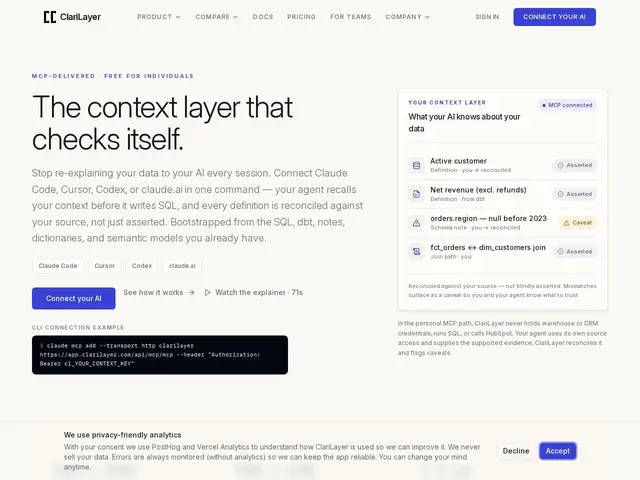
Description
AI assistants are amnesiacs: ask Claude or Cursor what "MRR" or "active customer" means in your company's database today, and you'll get a plausible-sounding guess, not the actual definition your team agreed on last quarter — and tomorrow's session starts from zero again. ClariLayer works like a shared notebook that every AI tool can read from and write to: it stores your real data definitions once (pulled from your SQL, dbt models, or CRM) and hands them to whichever assistant is working, so the answer stays consistent across Claude Code, Cursor, Codex, and claude.ai.
Technically, ClariLayer is delivered as an MCP server that bootstraps context from SQL schemas, dbt docs, CLAUDE.md files, data dictionaries, or semantic models, then exposes three operations to any connected agent: recall (pull relevant context mid-task), remember (save new definitions or corrections), and reconcile (check a saved definition against live warehouse results or HubSpot data to catch drift). It never holds your warehouse credentials directly, and the free tier is unmetered for individual use — team-wide governance (shared definitions, approval workflows, audit trail of disagreements) is still in private pilot under the paid "Governed Context Edge" tier.
💬 Our review
The short version: if your team has ever had two people build two dashboards with two different definitions of "active user," ClariLayer is trying to fix the AI-assistant version of that problem — a single source of truth that Claude, Cursor, and friends actually consult instead of guessing.
Against the alternative of just pasting a glossary into CLAUDE.md or a Claude Project, ClariLayer's edge is the reconcile step — it can actively check a stored definition against your live warehouse rather than trusting a document that might already be stale, and it works across multiple AI tools rather than being locked to one vendor's memory feature. That's a real gap in the market: most "AI context" tools solve retrieval, not correctness. The catch is that this is genuinely early — there's no public GitHub repo to inspect, no independent numbers behind its accuracy claims, and the team-collaboration tier that would matter most to a company (not a solo analyst) is still gated behind a private pilot with custom pricing. For a single data analyst juggling AI tools today, the free tier costs nothing to try. For a team wanting the actual governance layer, you're an early design partner, not a self-serve customer yet.
💰 Pricing
📊 Global score
🤖 AI-enriched data
Free Core tier unmetered for individual use, no card required. Team tier (Governed Context Edge) is custom-priced and currently in private pilot only.
Pros
Reconciles stored definitions against live warehouse/CRM data instead of trusting a stale doc
Works across multiple AI tools (Claude Code, Cursor, Codex, claude.ai) via MCP, not locked to one vendor
Free tier is genuinely unmetered for individual use
Cons
Team/governance tier still in private pilot, no self-serve pricing
No public GitHub repo or independent verification of accuracy claims
New, unproven at scale beyond design-partner teams