Bump.sh
A tool that turns your API's technical spec file into a clean, browsable documentation website automatically, and flags it the moment a change would break someone else's integration.
🔗 Visit Bump.sh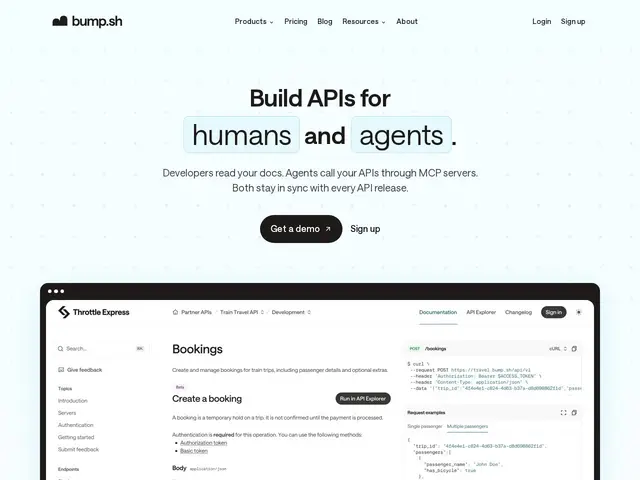
Description
Keeping API documentation in sync with the actual API is a chore most teams lose — someone changes an endpoint, forgets to update the docs, and a partner's integration breaks without warning. Bump.sh removes the manual step entirely: it reads your OpenAPI or AsyncAPI specification file and generates the documentation portal automatically, so the docs are always a direct reflection of the real API rather than a document someone has to remember to edit.
Bump.sh is a documentation platform built specifically around API specs (OpenAPI, AsyncAPI, and Arazzo), with automated breaking-change detection that shows a diff preview directly in pull requests before a change ships. It integrates natively into Git-based CI/CD workflows, supports white-labeling with SSO/SAML/OIDC for enterprise rollout, and produces automated changelogs. More recently it added MCP server hosting with built-in authentication, letting AI agents safely query and consume APIs through a governed interface rather than scraping documentation. It's built by a small France-based remote team and counts MongoDB, Elastic, and Redpanda among its customers.
💬 Our review
The short version: if your team maintains a public or partner-facing API and keeps shipping undocumented breaking changes, Bump.sh's spec-driven docs and PR-level breaking-change detection directly fix that — it's a narrow but well-executed tool, not a general documentation platform.
Against manually maintained docs or a general tool like Document360, Bump.sh's advantage is specificity: because it works directly from the OpenAPI/AsyncAPI spec, the documentation genuinely can't drift out of sync with the API in the way hand-maintained docs eventually do, and the PR-level breaking-change warnings catch problems before they ship rather than after a partner complains. The MCP server hosting addition is a smart bet on AI agents needing structured, safe API access rather than scraping HTML docs. At $50-250/month with no free tier, it's a meaningful cost for a small team, but the value case is clear for anyone with real API consumers who depend on stability.
💰 Pricing
📊 Global score
🤖 AI-enriched data
Basic à 50 $/mois (10 documentations API). Pro à 250 $/mois (30 documentations API + 50 outils MCP). Sur devis pour l'illimité. Pas de palier gratuit ; essai gratuit de 14 jours sur le plan Pro.
Pros
Documentation générée directement depuis la spec OpenAPI/AsyncAPI — ne peut pas diverger de l'API réelle
Détection des breaking changes avec aperçu de diff dans les pull requests
Hébergement de serveurs MCP avec authentification intégrée pour les agents IA
Clients notables : MongoDB, Elastic, Redpanda, Lightspeed
Cons
Aucun palier gratuit, à partir de 50 $/mois
Outil spécialisé API — pas une solution de documentation générale
Petite équipe (6 personnes) — support et roadmap à taille limitée
Nécessite déjà une spec OpenAPI/AsyncAPI propre pour en tirer profit