Multiplayer
A bridge between your AI coding assistant and what's actually happening in production, so tools like Claude Code or Copilot can see the real error and fix it, instead of guessing from a bug report alone.
🔗 Visit Multiplayer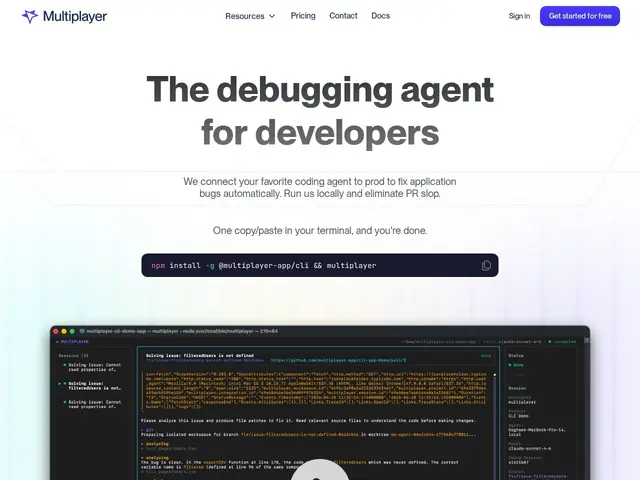
Description
AI coding assistants are good at fixing bugs they can see, but a bug report usually just says 'checkout is broken' — the assistant has no direct view of the actual request that failed in production. Multiplayer closes that gap: it correlates real production data (requests, responses, logs) with the bug, and hands that full context to whatever coding agent you're already using, so the fix is grounded in what actually happened rather than a guess.
Multiplayer is an open-source (MIT licensed) debugging agent that connects coding assistants like Claude Code and GitHub Copilot to production environments without giving them direct codebase access. It operates local-first with data caching, correlates full-stack data including request and response content, and uses intelligent issue deduplication to avoid flooding a repo with redundant pull requests for the same underlying bug. It's used by companies ranging from startups to large enterprises including IKEA, Walmart, SAP, and AT&T.
💬 Our review
The short version: if your team already uses an AI coding agent and gets frustrated by bug fixes based on incomplete reports, Multiplayer's production-context bridge is a smart, narrow fix — free to self-host if you want to try it with no commitment.
Its open-source, self-hostable model is the real selling point versus a closed observability platform: teams can inspect exactly what data crosses the wire between production and the AI agent, which matters for anyone cautious about handing production data to an AI tool. The enterprise customer list (IKEA, Walmart, SAP, AT&T) suggests it holds up at scale despite being a newer project (launched June 2026, still only 37 GitHub stars at last check) — early traction with big names is a good signal, but the small star count means less community-tested edge cases than more mature tools. At $12/user/month for the hosted tier, it's a low-risk add-on to an existing AI coding workflow.
💰 Pricing
📊 Global score
🤖 AI-enriched data
Version open source auto-hébergée gratuite (licence MIT). Palier hébergé à 12 $/utilisateur/mois avec SSO et rétention de 30 jours. Tarification entreprise sur devis.
Pros
Open source, auto-hébergeable, licence MIT
Compatible avec plusieurs agents de code (Claude Code, Copilot)
Corrélation complète des données full-stack (requêtes/réponses)
Déduplication intelligente des tickets pour éviter le bruit de PR redondantes
Cons
Projet encore jeune (lancé juin 2026), seulement 37 étoiles GitHub
Moins de retours communautaires que des outils d'observabilité établis
Nécessite déjà un agent de code IA en place pour tirer profit de l'outil
Palier hébergé facturé par utilisateur, coût qui grimpe pour une grande équipe