Ona
A fleet of AI software engineers that fix bugs, patch security holes, and modernize old code on their own, running inside your company's private cloud with a full audit trail of what they did.
🔗 Visit Ona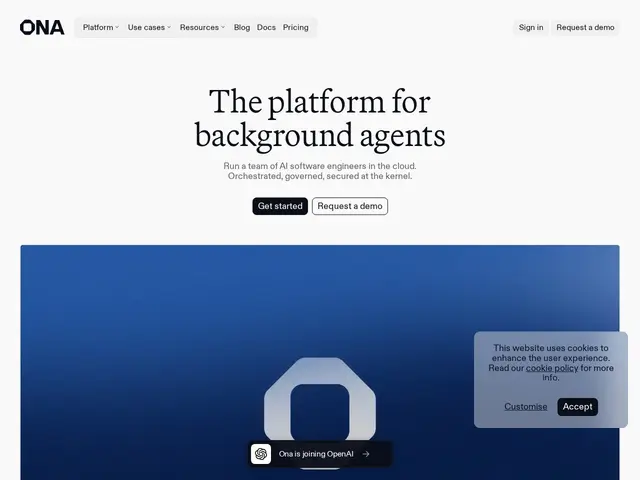
Description
Large engineering organizations sit on mountains of maintenance work — outdated dependencies, known CVEs, small recurring bugs — that never feels urgent enough to staff, so it piles up indefinitely. Ona is built to chip away at that pile automatically: it runs autonomous AI agents that pick up tasks (triggered by a pull request, a schedule, or a webhook) and carry them through to a finished fix, without an engineer babysitting each one.
Ona is a cloud platform for orchestrating fleets of autonomous AI software engineering agents, executing inside a company's own VPC with kernel-level security controls rather than a shared multi-tenant environment. It's positioned for enterprise-scale work — code modernization, bug fixing, security patching and CVE remediation — with full audit trails and governance controls to satisfy compliance requirements. Ona joined OpenAI in June 2026 and counts Fortune 500 customers including BNY, GSR, Vanta, Pearson, and EquipmentShare; it's SOC 2 Type II certified and GDPR compliant.
💬 Our review
The short version: Ona is built for large, security-conscious engineering organizations that want autonomous AI agents chewing through maintenance backlog inside their own private cloud, with the compliance paperwork to match — it's overkill for a small team's occasional bug fix.
What sets Ona apart from lighter-weight AI coding agents is the enterprise infrastructure: VPC-isolated execution, kernel-level security, SOC 2 Type II certification, and full audit trails, which matter a lot to a bank or healthcare company but add real overhead a small startup doesn't need. Its acquisition by OpenAI in mid-2026 is a meaningful signal of staying power and likely future model access, but also means roadmap direction is now tied to OpenAI's broader agent strategy rather than an independent one. At $20/month for the Core plan supporting up to 100 team members, the entry price is surprisingly reasonable given the target market — the real cost consideration is usage-based OCU consumption as agent activity scales.
💰 Pricing
📊 Global score
🤖 AI-enriched data
Core à 20 $/mois (80 à 2 200 OCU inclus, jusqu'à 100 membres d'équipe sans coût de poste supplémentaire). Enterprise sur devis. OCU additionnelles à partir de 10 $/40 OCU.
Pros
Exécution isolée en VPC privé avec contrôles de sécurité au niveau noyau
Certifié SOC 2 Type II et conforme RGPD
Clients Fortune 500 confirmés (BNY, GSR, Vanta, Pearson, EquipmentShare)
Rejoint OpenAI en juin 2026 — accès probable aux futurs modèles en priorité
Cons
Infrastructure et conformité pensées pour la grande entreprise — overkill pour une petite équipe
Feuille de route désormais liée à la stratégie agents d'OpenAI
Coût réel dépend de la consommation d'OCU à l'usage, moins prévisible qu'un forfait fixe
Année de fondation non communiquée