Potpie
An open-source tool that builds AI agents which actually understand how your codebase fits together — not just individual files — so they can debug, plan features, and answer questions grounded in the real structure of your code.
🔗 Visit Potpie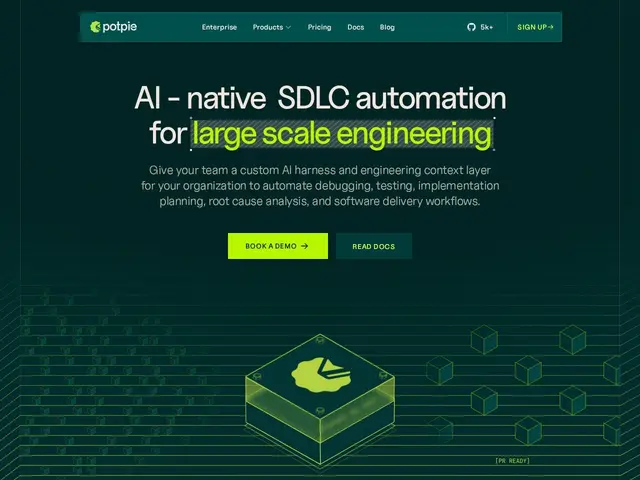
Description
Most AI coding assistants read whatever file is open and guess at the rest, which falls apart on large codebases where the real logic spans dozens of interconnected files. Potpie takes a different approach: it builds a knowledge graph of your entire codebase first — how functions call each other, how modules depend on one another — and then creates custom AI agents that reason using that map, instead of guessing from a narrow window of code.
Potpie is an open-source (Apache 2.0) platform for building task-specific code agents aimed at engineering teams managing large codebases, with GitHub, Slack, and Notion integrations for surfacing results where teams already work. Its knowledge graph approach is meant to give agents genuine codebase-wide understanding for tasks like debugging, test generation, and implementation planning, with full audit trails for traceability. It's model-agnostic and language-agnostic, and companies can self-host it or use their own LLM API keys instead of paying per request through Potpie directly.
💬 Our review
The short version: if you're an engineering team wrestling with a large, sprawling codebase where generic AI assistants keep losing context, Potpie's knowledge-graph approach targets exactly that pain point — and being open source with a free tier means you can validate the claim before committing.
Against general-purpose coding assistants like Cursor or GitHub Copilot, Potpie's differentiator is explicit: it builds a structural map of the codebase first, rather than relying on a context window of recently opened files, which should make it stronger on tasks spanning many files (debugging a cross-service bug, planning a feature that touches multiple modules). The tradeoff is that knowledge-graph-based tools are newer and less battle-tested at scale than mainstream assistants, and the free tier's 50 requests/month is really just enough to kick the tires, not run a team on. Worth evaluating seriously if codebase size is the actual bottleneck for your AI tooling; if your codebase is small, a simpler assistant will likely do the job with less setup.
💰 Pricing
📊 Global score
🤖 AI-enriched data
Gratuit (50 requêtes/mois, ou illimité avec vos propres clés API). Enterprise sur devis (requêtes illimitées, LLM auto-hébergé, déploiement on-premise).
Pros
Open source (Apache 2.0), auditable et auto-hébergeable
Compréhension du dépôt via un graphe de connaissances, pas juste un fichier isolé
Agnostique au langage et au modèle IA
Intégrations GitHub, Slack, Notion pour rester dans le flux de travail existant
Cons
Palier gratuit limité à 50 requêtes/mois — juste un aperçu
Approche par graphe de connaissances moins éprouvée à grande échelle que les assistants généralistes
Peu d'intérêt pour une petite base de code simple
Année de fondation non communiquée