Greplica
Gives an AI coding agent a real memory of your codebase — the decisions made, the approaches that failed, the constraints that matter — so it stops re-learning your project from scratch in every new session.
🔗 Visit Greplica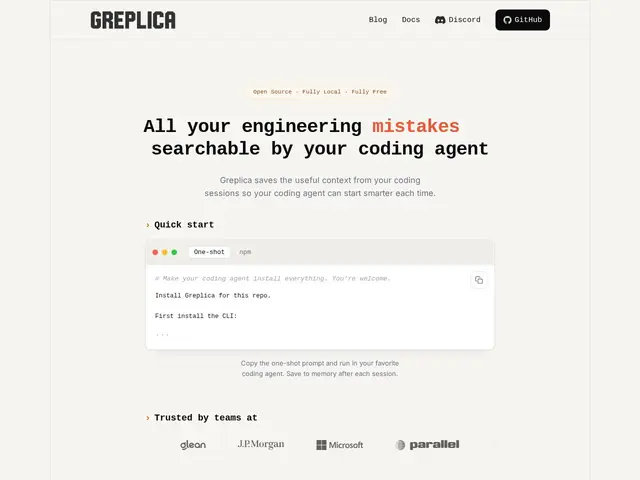
Description
AI coding agents like Claude Code or Cursor are sharp within a single session but forget everything between them, which means re-explaining the same architectural decisions and past mistakes over and over. Greplica addresses this directly: it scans your repository's structure, code, and past coding-session transcripts to build a persistent, searchable memory — decisions, constraints, gotchas, and failed approaches — that an agent can query before diving into a task instead of re-exploring blind.
It's open-source and deliberately local-only: everything is stored in a graph database on your own machine (~/.greplica/graph.db) with no cloud sync and no telemetry, which is a meaningful trust signal for teams wary of sending proprietary code context to a third-party server. Retrieval combines keyword search, semantic embeddings, and graph connections rather than a flat text search, and it's designed to plug into Claude Code as a skill. The company reports 40-50% token savings in planning tasks from showcased benchmarks, a self-published figure from a genuinely small, early tool.
💬 Our review
The short version: Greplica addresses a real and increasingly common frustration — AI coding agents forgetting project context between sessions — with a sensible, privacy-respecting local-only design, and being free and open source means there's essentially no downside to trying it.
Against commercial memory layers built into tools like Cursor or GitHub Copilot Workspace, Greplica's local-only storage is a genuine differentiator for teams that don't want proprietary codebase context leaving their machine — no cloud sync means no vendor to trust with that data. Against simpler approaches like maintaining an AGENTS.md file by hand, Greplica automates the capture of decisions and gotchas from actual coding sessions rather than relying on someone remembering to write them down, which is a real reduction in manual overhead. The trade-off of local-only storage is the flip side of its privacy advantage: there's no built-in way to share that memory across a team working on the same repo from different machines, so it's currently better suited to a solo developer or a single machine than a distributed team. A sensible, low-risk tool to install if you're already using Claude Code or similar agents on a codebase with real history worth remembering; less relevant for brand-new projects that don't yet have accumulated decisions to capture.
💰 Pricing
📊 Global score
🤖 AI-enriched data
Entièrement gratuit et open source, aucun palier payant. Installation locale via npm, stockage sur la machine de l'utilisateur.
Pros
Entièrement open source et gratuit, sans synchronisation cloud ni télémétrie
Stockage 100% local, les données ne quittent jamais la machine
Recherche hybride : mots-clés, embeddings sémantiques, graphe de connexions
S'intègre nativement comme skill Claude Code
Cons
Stockage local uniquement, pas de synchronisation d'équipe
Écosystème plus restreint que les alternatives commerciales
Nécessite une installation et intégration manuelle via npm