Document360
A dedicated home for your product documentation and help center, with an AI layer that lets customers — or even ChatGPT and Claude — ask questions and get answers pulled straight from your docs.
🔗 Visit Document360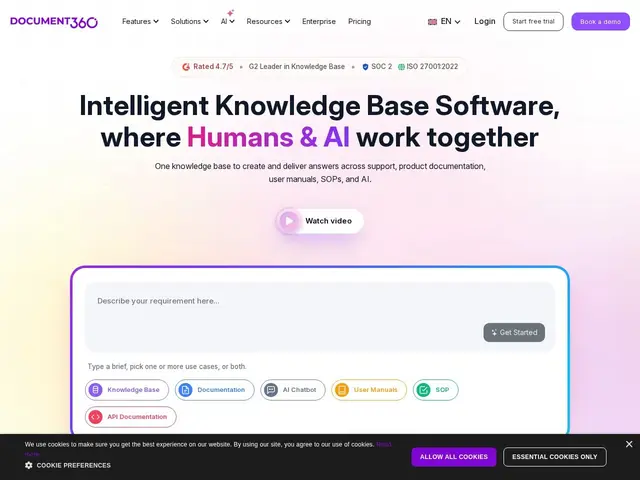
Description
Many companies end up writing their documentation in a tool that wasn't built for it — a wiki, a shared doc, a folder of PDFs — which makes it hard to search, version, and keep current as the product changes. Document360 is built specifically for this job: it's a dedicated knowledge-base platform where teams write, organize, and publish documentation, with version control so you can track how an article changed over time and roll back if needed.
What sets it apart technically is how far it leans into AI on both the writing and reading side: an AI writing agent can draft documentation from a video walkthrough or an uploaded file, a conversational AI search cites its sources rather than just returning links, and it plugs directly into ChatGPT, Claude, and Copilot via MCP (Model Context Protocol) so those assistants can pull answers straight from your docs. It targets support teams, technical writers, and product teams, with a heavier concentration of enterprise buyers in healthcare, financial services, and manufacturing who need SSO, granular privacy controls per knowledge base, and workflow approvals — all of which come at custom, quote-only pricing.
💬 Our review
The short version: Document360 is a mature, feature-dense documentation platform whose AI tooling (source-cited search, AI writing agent, native MCP integration) is genuinely ahead of most competitors, but you'll get zero pricing information until you talk to sales, which is a real friction point for a self-serve buyer just wanting to compare costs.
Against Confluence or Notion, Document360's advantage is that it's purpose-built for external, customer-facing documentation — version history, article-level analytics, and a clean reader-facing site are first-class, not bolted on. Against GitBook, it goes deeper on enterprise controls (SSO, SCIM, per-knowledge-base privacy) and now the MCP integration is a meaningful edge if your users are increasingly asking AI assistants questions instead of searching docs directly — that's a real, forward-looking bet that's paying off as more support flows through chat interfaces. The custom-pricing-only model is the main drawback: without a published number, it's hard to know upfront whether Document360 costs more or less than Confluence or GitBook for your team size, and the 14-day trial, while full-featured, still requires evaluating a fairly complex tool in a short window. Worth serious evaluation for a company already committed to investing in documentation as a product; overkill for a small team that just needs a simple public wiki.
💰 Pricing
📊 Global score
🤖 AI-enriched data
Aucun tarif fixe publié. Le prix varie selon le nombre de comptes équipe, d'espaces de travail, de langues, des exigences SSO/sécurité, du modèle de confidentialité de la base de connaissances et de l'usage de la suite AI Premium. Essai gratuit de 14 jours sans carte bancaire. Devis obtenu via équipe commerciale ou démo.
Pros
Recherche IA conversationnelle avec citation des sources
Agent d'écriture IA générant des docs à partir de vidéos ou fichiers
Intégration native MCP avec ChatGPT, Claude, Copilot
Plus de 100 fonctionnalités : workflow, SSO/SCIM, analytics avancés
Cons
Aucun tarif transparent — contact commercial obligatoire pour tout devis
Complexité tarifaire pouvant décourager les petites équipes en self-serve
Pas de calculateur de prix en ligne