Rho
A business bank account, corporate cards, and bill-paying tool in one, built to replace the usual patchwork of a bank, a card provider, and separate expense software for growing companies.
🔗 Visit Rho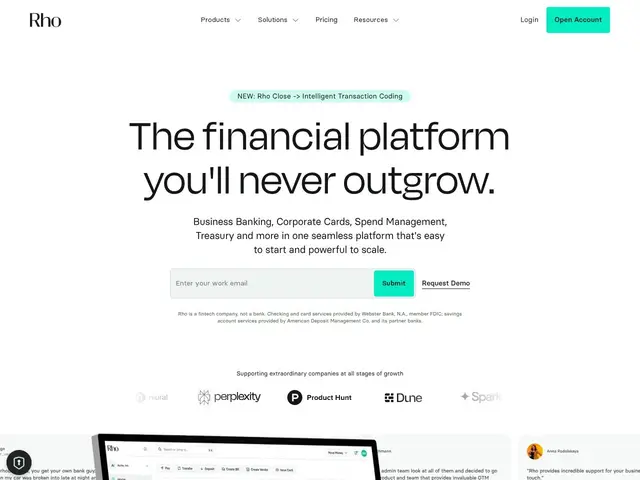
Description
Most growing companies end up juggling a business bank account from one provider, corporate cards from another, and a third tool for expense tracking and bill payments — none of which talk to each other well. Rho bundles all three into a single platform: a business checking account, corporate cards with spend controls, automated bill pay, invoicing, and bookkeeping reconciliation that syncs with your accounting software.
Its headline pitch is a zero-fee core banking model — no subscription, no per-user fees, no ACH/wire/check fees, no minimum balance fees — which it can offer because, like many neobank-style fintechs, it earns revenue from card interchange fees rather than charging customers directly. It also offers a treasury management product for parking idle cash (up to roughly 4.5% yield depending on deposit size, run through an SEC-registered investment advisor), which becomes more attractive at higher deposit tiers. Access requires an application and typically a demo rather than instant self-serve signup, and it's aimed at startups, scale-ups, and finance teams (including outsourced/fractional CFOs) managing multiple entities.
💬 Our review
The short version: Rho is a solid, no-fee alternative to stitching together a bank, a card provider, and expense software separately — competitive with Mercury and Brex on the banking-plus-cards front, with treasury management as a genuine differentiator for companies sitting on meaningful cash reserves.
Against Mercury or Brex, the core banking and card experience is broadly comparable — free accounts, spend controls, expense automation — so the decision often comes down to secondary features (Rho's built-in bill pay and bookkeeping reconciliation vs. competitors' own ecosystems) and account-opening experience, which varies by company profile. The treasury yield tiers reward companies with larger cash balances more than small startups just getting started, and since it's not instant self-serve, expect an application and likely a sales conversation before you're live. For a company that wants banking, cards, and AP/AR in one dashboard without vendor sprawl, it's worth comparing directly against Mercury and Brex before choosing.
💰 Pricing
📊 Global score
🤖 AI-enriched data
Compte et cartes sans frais d'abonnement, sans frais par utilisateur, sans frais ACH/virement/chèque, sans solde minimum. Virements internationaux : 1% de conversion. Gestion de trésorerie : de 0,15% (dépôts 20M$+) à 0,6% (dépôts <2M$).
Pros
Zéro frais d'abonnement, de compte ou de carte grâce au modèle basé sur l'interchange
Plateforme unifiée : banque, cartes, paiement de factures, facturation, rapprochement comptable
Rendement de trésorerie compétitif (jusqu'à ~4,5%) sur la trésorerie inactive
Cons
Nécessite une candidature/démo, pas d'inscription instantanée en libre-service
Les meilleurs taux de trésorerie exigent des dépôts élevés
Marché principalement américain