m3ter
A billing engine, now owned by Salesforce, that turns raw product-usage data into accurate invoices for companies that charge by consumption instead of flat monthly fees.
🔗 Visit m3ter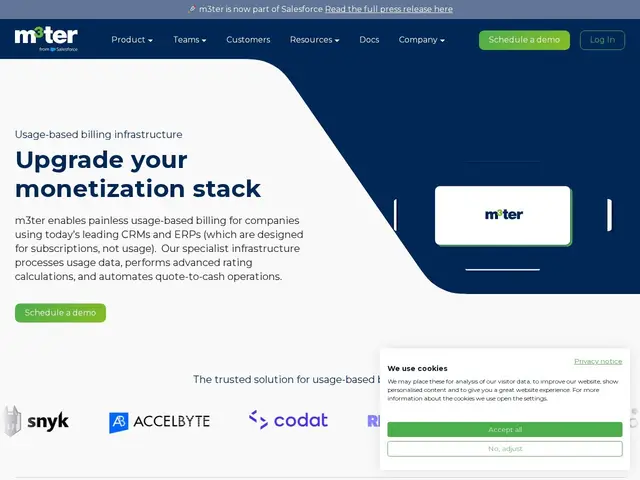
Description
If your product charges people based on how much they use it — API calls, storage, compute minutes — instead of a flat monthly fee, you already know that billing gets messy fast. Someone has to reliably count every unit of usage, apply the right price to it (which might change by customer, by volume tier, or by contract), and turn that into an invoice that actually matches what happened. m3ter is a piece of infrastructure built specifically to do that counting-and-pricing job so a finance team doesn't have to stitch it together in spreadsheets.
m3ter ingests usage events at scale, applies flexible pricing logic (tiered, volume-based, hybrid commit-plus-overage), and pushes the results into quote-to-cash workflows connected to CRM and ERP systems like Salesforce and NetSuite — unsurprising given Salesforce acquired the company. It's positioned to prevent the revenue leakage that commonly happens when usage-based pricing is handled manually or half-automated, which vendors in this space estimate at 4-7% of revenue. There's no self-serve signup or public pricing: it's sold through a demo-and-quote sales process aimed at mid-size to large B2B SaaS companies with genuinely complex billing needs, not solo developers or early-stage startups.
💬 Our review
The short version: m3ter is a credible enterprise pick for usage-based billing, especially if you're already deep in the Salesforce ecosystem — but the total absence of public pricing and the demo-only sales process make it a poor fit for anyone who isn't already sure they need enterprise-grade billing infrastructure.
Against competitors like Stripe Billing, Metronome, or Zuora, m3ter's differentiator is really its Salesforce ownership: if your company already runs its CRM and revenue operations through Salesforce, the native integration story is stronger than a third-party tool bolted on afterward. That's also its main limitation for everyone else — you're evaluating a Salesforce product, with the pricing opacity and sales-led motion that implies, rather than a developer-first tool you can try in an afternoon. For a startup or small SaaS company just adding usage-based pricing for the first time, Stripe Billing or a lighter tool like Lago will likely be faster to adopt and cheaper to start. For a mid-market or enterprise company already living in Salesforce's orbit and outgrowing spreadsheet-based billing, m3ter is worth putting on the shortlist against Zuora and Metronome.
💰 Pricing
📊 Global score
🤖 AI-enriched data
Aucun tarif public. Frais de plateforme mensuel + add-ons volumétriques (ingestion de données d'usage, intégrations CRM/ERP) + support. Démo commerciale obligatoire pour obtenir un chiffrage.
Pros
Intégration native avec Salesforce et NetSuite (m3ter appartient désormais à Salesforce)
Gère des modèles de prix complexes : paliers, volume, hybride engagement+dépassement
Automatise tout le cycle quote-to-cash pour réduire les pertes de revenu liées à une facturation d'usage mal suivie
Cons
Aucun tarif public, processus de vente uniquement sur démo
Positionnement entreprise qui exclut de fait les petites équipes SaaS
Pas d'essai gratuit ni de version freemium