Fish Audio
A large library of AI voices you can generate speech from, clone from a short recording, or transcribe audio with — built for podcasters, YouTubers, and developers who need voice in their product.
🔗 Visit Fish Audio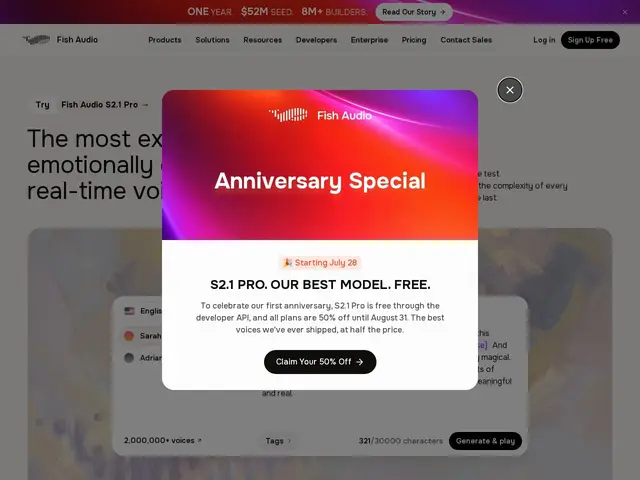
Description
Adding a convincing voice to a video, podcast, or app used to mean either hiring a voice actor or accepting robotic-sounding text-to-speech. Fish Audio gives creators and developers a library of over 2 million community-uploaded voices to generate speech from, plus the ability to clone a voice from just 10-15 seconds of sample audio, transcribe existing audio, and add emotional inflection (angry, sad, excited, whispering) to the output.
It supports 30+ languages, offers real-time audio streaming for live use cases, and includes a "Story Studio" specifically for audiobook production, alongside REST and WebSocket APIs with an official Python SDK. Pricing is credit-based: Free gives 8,000 credits a month (about 7 minutes of generation, personal use only), with paid tiers from $5.50/month (Plus) up to $749/month (Max) for heavy commercial volume, plus custom Enterprise pricing with zero data retention and on-premise deployment. The company raised $52M in seed funding (Coreline Ventures, Capital Today) in July 2026, and maintains a genuinely active open-source presence — its fish-speech model has 31,800 GitHub stars, among the more credible signals in a market full of unverifiable voice-AI claims.
💬 Our review
The short version: Fish Audio is a real, well-funded competitor to ElevenLabs with a distinctive edge — a massive 2M+ voice library and a strong open-source track record (fish-speech, Bert-VITS2) that most closed competitors can't match for transparency.
The open-source presence matters here more than marketing copy: 31,800 stars on the underlying model is a harder signal of technical credibility than funding announcements alone, and it gives technical buyers a way to evaluate the actual model quality before committing budget. The pricing structure is reasonably transparent (unlike several other voice-AI startups reviewed this batch that disclose no pricing at all), but the free tier's non-commercial restriction and lack of credit rollover mean actual usage costs will climb faster than the sticker price suggests once you're shipping a real product — the $749/month Max tier is a meaningful jump from the $37.50 Pro tier if you scale past it. Against ElevenLabs specifically, the differentiators are the sheer size of the community voice library and the open-source ecosystem; if you need enterprise guarantees like zero data retention or on-premise deployment, that's available too, just at custom pricing.
💰 Pricing
📊 Global score
🤖 AI-enriched data
Gratuit : 8 000 crédits/mois (~7 min), usage personnel uniquement. Plus : 5,50$/mois. Pro : 37,50$/mois. Max : 749$/mois. Enterprise : sur devis (rétention de données zéro, déploiement sur site).
Pros
Bibliothèque de plus de 2 millions de voix communautaires
Écosystème open source solide et vérifiable (fish-speech : 31 800 étoiles GitHub)
Tarification relativement transparente comparée à d'autres startups vocales IA
Cons
Palier gratuit limité à un usage non commercial
Les crédits mensuels ne se reportent pas d'un mois à l'autre
Coût qui grimpe vite en usage intensif (749$/mois au palier Max)