KeyHunter
A fast, free command-line tool that searches GitHub for leaked API keys and then actually tests each one to confirm whether it still works — instead of just flagging text that looks like a key.
🔗 Visit KeyHunter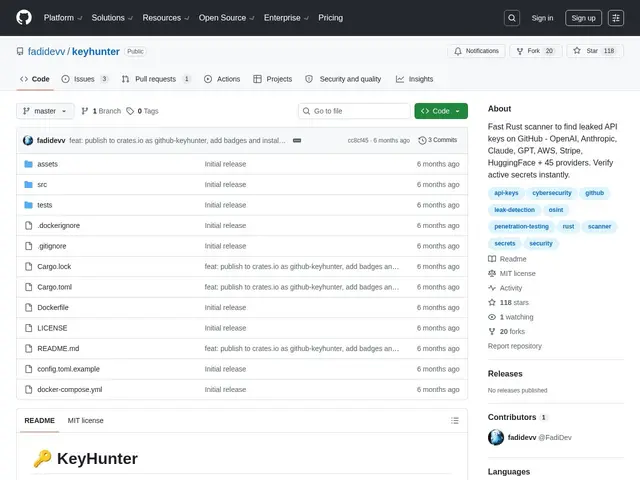
Description
Most secret scanners find text that matches the pattern of an API key, but can't tell you whether that key is still valid — that requires actually testing it, which KeyHunter does for 20+ providers. Written in Rust for speed, it supports 45+ providers across AI/LLM services (OpenAI, Anthropic), cloud platforms, payment processors, and databases, and uses parallel scanning with token rotation to work around GitHub's API rate limits during large searches.
It's free and open source under the MIT license, runs via Docker with no Rust installation required, and supports multiple output formats (table, JSON, CSV) including a "verified-only" mode that filters results down to just the keys confirmed to be active. It also handles interruption gracefully, saving partial results rather than losing a long-running scan.
💬 Our review
The short version: the live-verification feature is the real value here — a list of "possible leaked keys" is far less useful than a short list of "keys we confirmed are still active," and that's what KeyHunter narrows results down to, for free.
Against similar GitHub-secret-hunting tools like KeySentry, KeyHunter's edges are speed (Rust, parallel scanning) and verification breadth (20+ providers actively tested, not just pattern-matched). The tradeoff is that it's a CLI-only tool with no web interface, so it's better suited to developers and security researchers comfortable at a terminal than to someone wanting a point-and-click scanner.
💰 Pricing
📊 Global score
🤖 AI-enriched data
Licence MIT, écrit en Rust, disponible via Docker.
Pros
Vérifie en direct si les clés trouvées sont encore actives (20+ fournisseurs)
Rapide (Rust), scan parallèle avec rotation de tokens
Gratuit, open source, support Docker
Cons
CLI uniquement, pas d'interface web
Nécessite de connaître la ligne de commande
Outil de niche récent