OpenWiki
A free command-line tool that writes and keeps your project's documentation up to date automatically, so an AI coding assistant (or a new teammate) always has an accurate map of a codebase instead of stale, hand-written docs.
🔗 Visit OpenWiki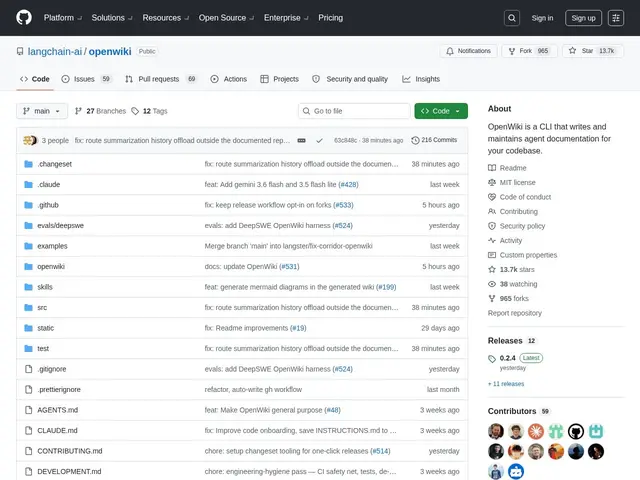
Description
Documentation almost always rots: someone writes it once, the code changes a dozen times after, and six months later it's actively misleading. OpenWiki attacks that problem by generating the docs from the codebase itself and refreshing them on demand, rather than relying on a human to remember to update a wiki page every time something changes.
Built by LangChain, OpenWiki is a TypeScript/Node.js CLI, MIT-licensed and free, that operates in two modes: generating documentation for a code repository, or maintaining a personal knowledge "brain" wiki. It pulls context from multiple connectors — Git history, Notion, Gmail, X/Twitter, web search, Hacker News — and can auto-generate Mermaid diagrams to visualize architecture and data flow, not just prose. It plugs into CI/CD via ready-made templates for GitHub Actions, GitLab CI, and Bitbucket Pipelines, and it explicitly targets the AI-agent workflow by generating and maintaining AGENTS.md and CLAUDE.md files, the increasingly standard "instructions for AI coding assistants" files that many agentic tools now read automatically. It launched in June 2026 and had already gathered over 13,000 GitHub stars within weeks.
💬 Our review
The short version: OpenWiki is a strong pick if your team already leans on AI coding agents and is tired of those agents working from stale or missing context — the AGENTS.md/CLAUDE.md generation specifically closes a gap most documentation tools don't even attempt.
Against Mintlify, the polished, hosted docs platform many startups pay for, OpenWiki's advantage is being free, self-hosted, and automated at generation time rather than requiring you to write docs by hand and have Mintlify just render them nicely — the tradeoff is you lose Mintlify's design polish and hosted search. Against Docusaurus, the open-source static-site generator for docs, the comparison is similar: Docusaurus is a publishing framework you still fill with hand-written content, while OpenWiki tries to generate that content from the repo itself. The closest real competitor is Swimm, which also auto-generates and syncs code documentation, but Swimm is a commercial product with IDE plugins and enterprise support, while OpenWiki is free, CLI-first, and newer. The honest caveats: it's Node.js-only despite LangChain's Python-heavy reputation, some dependencies (like better-sqlite3) may need native compilation on install, and being barely a month old at review time means rough edges are still likely. For a team wanting zero-cost, automated, agent-friendly docs today, it's worth trying; for a team that needs a polished public-facing docs site with design control, Mintlify or Docusaurus remain the safer choice.
💰 Pricing
📊 Global score
🤖 AI-enriched data
Licence MIT, entièrement gratuit et open source, installation via npm/pnpm.
Pros
Multi-fournisseurs d'inférence (OpenAI, Anthropic, Gemini, GitHub Copilot, AWS Bedrock)
Génère automatiquement des diagrammes Mermaid pour visualiser architecture et flux de données
Génère et maintient les fichiers AGENTS.md / CLAUDE.md lus par les agents de codage IA
Cons
TypeScript/Node.js uniquement, malgré l'écosystème LangChain plutôt orienté Python
Dépendances natives (ex. better-sqlite3) pouvant nécessiter une compilation à l'installation
Projet très jeune (juin 2026), stabilité encore à prouver