Herdr
A free terminal app that lets you run several AI coding agents at once and keep track of what each one is doing, instead of juggling a pile of separate terminal windows or tabs.
🔗 Visit Herdr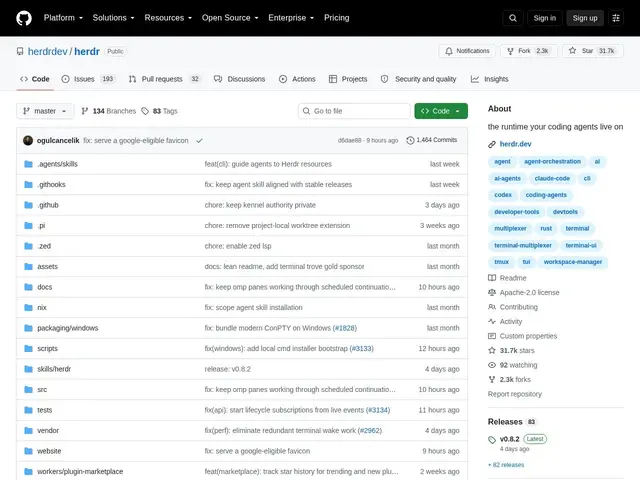
Description
If you've ever tried running two or three AI coding assistants on different tasks at the same time, you know the problem: which terminal window is which agent, is it still running, did it finish or get stuck? Herdr is built specifically to solve that — think of it as mission control for a small fleet of AI agents working in parallel, showing you each one's live status in a single terminal screen instead of forcing you to alt-tab between windows.
Herdr is a native Rust application (no Electron overhead) distributed under Apache 2.0, installable via curl, Homebrew, Mise, or PowerShell. Its core feature is session persistence: agents keep running even after you detach from the terminal, so a long task doesn't die because you closed your laptop lid. It exposes a socket API for integrating custom agents and supports a plugin marketplace for extending functionality. At version 0.4.0 with over 22,000 GitHub stars, it's clearly resonating with developers running multi-agent workflows, even though it's still an early-stage project.
💬 Our review
The short version: Herdr is a genuinely useful piece of infrastructure if you're already running multiple AI coding agents in parallel and tired of losing track of them, but it's a narrow, young tool — not a general terminal replacement, and not something to reach for if you only ever run one agent at a time.
Against tmux with custom scripts, the DIY approach many developers currently use to juggle multiple agent sessions, Herdr's advantage is purpose-built visibility: status tracking, lifecycle management, and a plugin system designed around agents specifically, rather than generic pane-splitting you have to wire up yourself. Against Zellij, a modern terminal multiplexer with a friendlier UX than tmux, Herdr again wins on agent-awareness but loses on being a general-purpose multiplexer — Zellij handles any terminal workflow, Herdr is scoped to coordinating agents. Against Warp, the AI-native terminal app with a polished GUI, Herdr trades visual polish for being lightweight, scriptable, and terminal-native rather than a full application. The real caveat is maturity: v0.4.0 means breaking changes are still plausible, and using the plugin system or socket API requires comfort with a less-documented interface than a mature tool would offer. If your daily workflow already involves three or more concurrent agent sessions, it's worth the setup time; if you run one agent at a time, plain tmux or your existing terminal is simpler and just as effective.
💰 Pricing
📊 Global score
🤖 AI-enriched data
Licence Apache 2.0, gratuit et open source.
Pros
Visibilité temps réel sur le statut et le cycle de vie de chaque agent
Persistance de session — les agents continuent de tourner après détachement du terminal
Implémentation native Rust, léger, sans overhead Electron
Cons
Projet jeune (v0.4.0), peu de recul en production
Focalisé sur les workflows d'agents IA, pas un multiplexeur terminal généraliste
API socket peu documentée pour intégrer ses propres agents ou plugins