Astryx
A free, open-source library of over 160 ready-made building blocks (buttons, forms, layouts) that developers drop into a website or app instead of designing every piece from scratch — and that AI coding assistants can use directly too.
🔗 Visit Astryx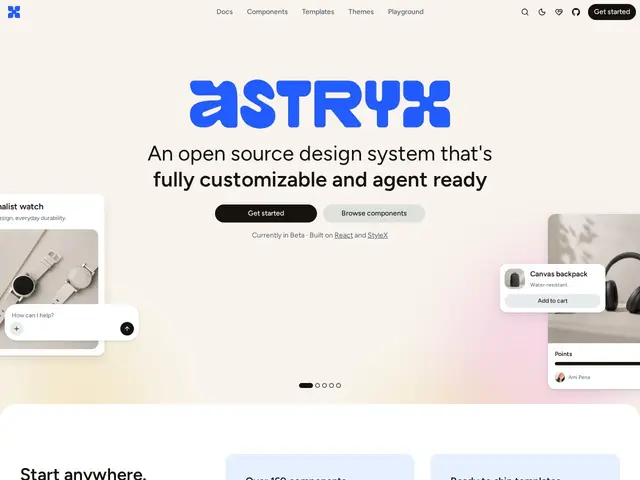
Description
Building a website or app from nothing means designing hundreds of small, repetitive pieces first — how a button looks, how a dropdown behaves, how a form validates — before you can even start on what makes your product unique. A design system like Astryx is a pre-made toolbox of those pieces, so a team can assemble screens quickly and have them look consistent, instead of reinventing buttons and menus for the tenth time.
Astryx is Meta's open-source design system: 160+ accessible React components released under the MIT license, with theming handled through CSS custom properties rather than a heavyweight styling library, so it composes cleanly at any level without locking you into a specific build plugin. Its distinguishing bet is being built for the AI-coding era — its docs, CLI, and API are structured to be consumed by coding agents via MCP just as readily as by a human developer, so an AI assistant wiring up a UI can pull accurate component usage directly from the source of truth instead of guessing from stale examples. It shipped in January 2026 and has already crossed 11,000 GitHub stars, reflecting both Meta's backing and the broader rush toward "agent-ready" tooling.
💬 Our review
The short version: Astryx is a technically solid, Meta-backed design system with a genuinely differentiated angle (agent-readiness), but it's six months old — pick it for the component quality and MIT license, not yet for ecosystem depth.
Against Radix UI, the low-level accessible-primitives library many design systems are built on top of, Astryx sits one layer higher: it gives you finished, styled components rather than unstyled primitives you assemble yourself, trading flexibility for speed. Against shadcn/ui, the current default choice for many React teams (copy-paste components you own and modify directly), Astryx is closer to a traditional installed package — less code ownership, but centralized updates and Meta's maintenance behind it. Against Chakra UI and Material UI, both mature and battle-tested with years of community plugins, Astryx's honest weakness shows: fewer third-party extensions, thinner advanced-customization docs, and a smaller Stack Overflow footprint if something breaks. The agent-readiness angle is real value if your team is already leaning on AI coding assistants for UI work, since accurate, structured docs measurably reduce hallucinated component APIs — but it's not yet a reason to migrate an existing shadcn/ui or Chakra codebase. Free and MIT-licensed either way, so the cost of trying it is just engineering time.
💰 Pricing
📊 Global score
🤖 AI-enriched data
Open-source, licence MIT, gratuit pour tout usage commercial ou non-commercial.
Pros
160+ composants React accessibles, prêts à l'emploi, avec templates de production
Pensé pour les agents IA : API/docs/CLI structurés pour un usage humain ET assisté (support MCP)
Theming via CSS custom properties, sans dépendance à une lib de style ni lock-in de build
Cons
Projet très jeune (janvier 2026), écosystème et adoption encore limités
Peu d'extensions ou de librairies tierces pour l'instant
Documentation centrée sur les bases, patterns avancés encore en construction