MemoryCustodian
A tool that keeps your project's history and past decisions written down as plain text files in your own code repository, so an AI coding assistant can read them instead of forgetting everything between sessions.
🔗 Visit MemoryCustodian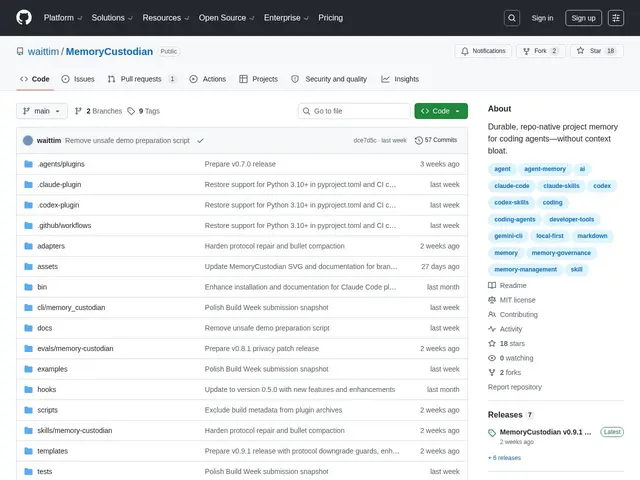
Description
AI coding assistants are famously forgetful — close the chat and tomorrow it has no idea why the team rejected a certain approach last month, or why a specific library was chosen over another. MemoryCustodian solves this in a low-tech, very transparent way: instead of a hidden database somewhere, it stores that project memory as plain Markdown files right inside your own code repository, the same way you'd store any other file — readable, reviewable, and tracked by Git like everything else.
MemoryCustodian is an open-source, repository-native memory system for AI coding agents (Claude Code, Codex, Gemini, and others). Decisions, constraints, and rejected approaches live as version-controlled Markdown rather than in a hosted service or a bloated system prompt. A manifest file routes only the memory relevant to the current task, avoiding context bloat as a project's history grows. Because it's just Markdown in Git, memory can be reviewed in pull requests, diffed, and deleted like any other code change, and it works across multiple different AI coding agents rather than locking you into one vendor's memory format.
💬 Our review
The short version: if you're tired of re-explaining the same project decisions to your AI coding agent every session, and you'd rather that memory live as plain, reviewable files in your own repo than in someone else's database, MemoryCustodian is a free and refreshingly simple way to do it.
The honest tradeoff is that being 'just Markdown in Git' is both its strength and its limit — there's no fancy semantic search or vector retrieval here, so recall quality depends on how well the manifest routes context, not on embeddings matching fuzzy queries. Compared to PMB, which builds a hybrid BM25 + vector + entity-graph retrieval system in a local SQLite file, MemoryCustodian trades retrieval sophistication for radical simplicity and git-native transparency — every memory change is a visible, reviewable diff, which matters a lot for teams who want an audit trail of why an AI agent made a call. It's worth using specifically if you value memory you can read, review in a PR, and delete like code, over a more powerful but opaque retrieval engine.
📊 Global score
🤖 AI-enriched data
100% gratuit, licence MIT, aucun service hébergé requis.
Pros
Mémoire stockée en Markdown brut directement dans le dépôt Git
Reviewable, diffable et supprimable comme n'importe quel fichier de code
Compatible multi-agents (Claude Code, Codex, Gemini)
Manifest qui ne charge que la mémoire pertinente à la tâche en cours
Cons
Pas de recherche sémantique/vectorielle, retrieval plus simple qu'une solution comme PMB
Dépend de la qualité du manifest pour router le bon contexte