Noisegate
An open-source gateway that lets an AI agent query your sensitive data while mathematically guaranteeing it can never learn about any single individual in that data.
🔗 Visit Noisegate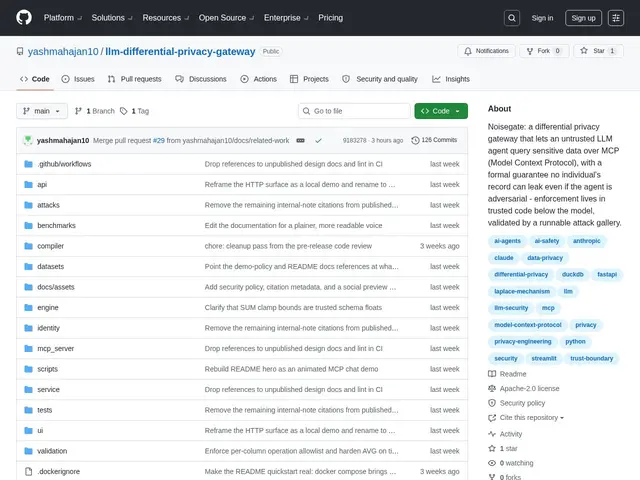
Description
When you let an AI agent loose on a database — say, to answer "what's our average customer age?" — you're trusting it not to slip in a follow-up question that reverse-engineers one specific person's record. Noisegate closes that gap by sitting between the agent and the data: every answer that comes back has a small amount of statistical noise deliberately mixed in, enough to make it mathematically impossible to isolate any individual, but not enough to meaningfully change an aggregate answer like an average or a count.
Under the hood, Noisegate implements differential privacy — the same mathematical framework used by the US Census Bureau — via a Laplace noise mechanism, with a hybrid zCDP (zero-concentrated differential privacy) budget-accounting scheme that the project claims triples the number of queries you can run compared to naive epsilon-based accounting (308 queries vs. 100 at the same privacy budget). It ships as an MCP server so it plugs directly into Claude Desktop and similar agent setups, sits below the LLM as a hard validation layer the agent can't talk its way around, and includes a genuinely unusual feature for a young open-source project: a runnable "attack gallery" that actually tries to break its own privacy guarantees (differencing attacks, membership inference, re-identification) as part of its CI test suite, plus cross-validation against OpenDP, the reference differential-privacy implementation, to nine decimal places.
💬 Our review
The short version: Noisegate is a rigorously engineered answer to a real and growing problem — AI agents with direct data access — and the fact that it ships runnable attacks against its own guarantees as regression tests is a level of self-skepticism you rarely see in a project this young.
Against OpenDP itself, which Noisegate validates against, the difference is scope: OpenDP is a general-purpose differential privacy toolkit you'd have to wire into your own agent stack yourself, while Noisegate is purpose-built as a drop-in MCP gateway for exactly the untrusted-agent scenario. Against Opacus (Meta's production-tested library) or TensorFlow Privacy, those tools apply differential privacy during model training, not at query time against a live database — a genuinely different use case. The honest caveat is adoption: this is a one-star, single-author project created a month ago, using (epsilon, delta)-differential privacy (a slightly weaker guarantee than pure epsilon-DP) and requiring Python 3.13+. The engineering rigor is real; the track record isn't yet. For a team seriously considering giving an AI agent query access to sensitive data today, it's worth evaluating closely — just don't mistake a well-tested attack gallery for years of production hardening.
💰 Pricing
📊 Global score
🤖 AI-enriched data
Open-source (Apache License 2.0), aucun modèle commercial. Auto-hébergé, gratuit.
Pros
Galerie d'attaques exécutables intégrée aux tests CI pour prouver les garanties de confidentialité
Validé mathématiquement contre OpenDP à 9 décimales près
Budget de confidentialité hybride (zCDP) permettant ~3x plus de requêtes qu'un comptage epsilon naïf
Cons
Projet très jeune (créé juin 2026), quasi aucune adoption en production (1 star)
Utilise (epsilon, delta)-DP, une garantie légèrement plus faible que le epsilon-DP pur
Nécessite Python 3.13+, limitant la compatibilité de déploiement