TownSquare
A tiny, free script you drop into any website so visitors see each other as little animated figures and can wave or chat in real time, no accounts needed.
🔗 Visit TownSquare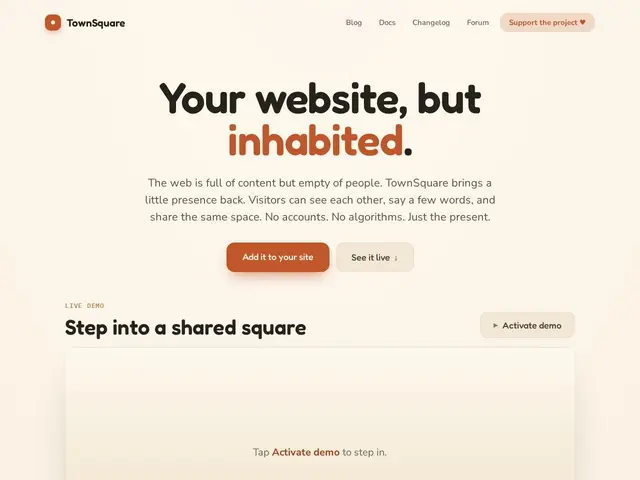
Description
Most websites feel empty even when hundreds of people are reading them at the same moment, because nobody can see anyone else. TownSquare fixes that by putting a thin strip of animated stick figures at the bottom of the page — each one is a real visitor, moving around live, who can type a quick message or wave hello. Nobody signs up, nothing is saved once you leave, and the whole point is to make a page feel like a room with other people in it instead of a lonely document.
Under the hood, TownSquare is a self-hostable Node.js (18+) service that ships as a single script tag with no build step — drop it before the closing body tag and it renders a live WebSocket-backed presence strip. It stores state on disk under a configurable DATA_DIR (no database required), ships an admin panel for moderation, and the creator also runs a free managed instance plus a public "network map" of every site that's added it. Being MIT-licensed and account-free by design, it fits cleanly into privacy-conscious stacks — it doesn't track, profile, or persist anything beyond the live session.
💬 Our review
The short version: if you run a blog, docs site, or community page and want visitors to feel a pulse of "other people are here right now" without adding accounts, analytics, or tracking scripts, TownSquare is a genuinely fun one-line addition that costs nothing and respects privacy by construction.
Against something like Hotjar or Intercom, TownSquare deliberately does far less — no session replay, no CRM, no lead capture — because that's not the point; it's a presence layer, not a business tool. Against building your own WebSocket presence widget, TownSquare saves the plumbing (reconnects, moderation, rendering) for free. The catch is maturity: it's a young, single-maintainer, MIT project with file-based storage that documentation admits isn't built for huge concurrent crowds yet, and self-hosting means running a Node service rather than a static include. For a personal site or small-to-mid community, that's a non-issue; for a page expecting thousands of concurrent visitors, test it first or lean on the managed instance.
💰 Pricing
📊 Global score
🤖 AI-enriched data
Gratuit et open-source (licence MIT), auto-hébergeable sans limite. Instance gérée gratuite également disponible chez le créateur. Aucun palier payant.
Pros
Installation en un seul script tag, aucune étape de build
Gratuit, open-source (MIT), auto-hébergeable avec Node.js 18+
Zéro compte utilisateur, zéro tracking, zéro donnée conservée après la session
Cons
Stockage sur fichiers, pas pensé pour de très gros volumes de visiteurs simultanés
Self-host nécessite un service Node.js, pas un simple fichier statique
Projet jeune, documentation encore limitée sur les déploiements avancés