CleverCrow
A platform where a project's community pools money against a specific GitHub issue, an AI coding agent proposes a fix in a sandbox, and the maintainer gets paid automatically once they merge it.
🔗 Visit CleverCrow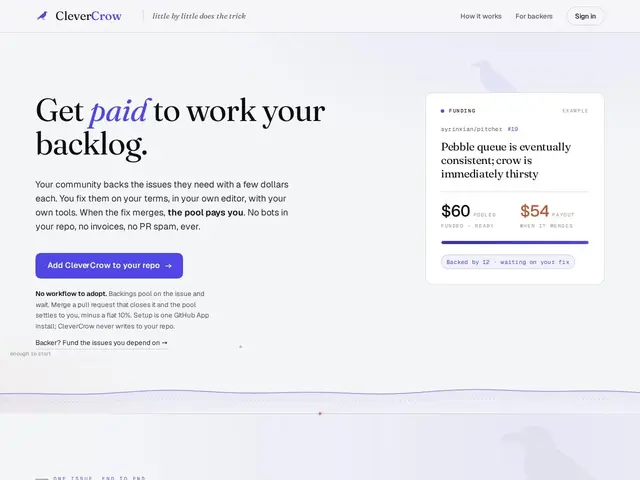
Description
Open-source maintainers famously do a lot of unpaid work, and the issues that annoy users most often aren't the ones maintainers feel like prioritizing for free. CleverCrow tries to close that gap: people who want a specific GitHub issue fixed can pool money against it, an AI coding agent drafts a plan and, once approved, opens a real pull request — and the moment the maintainer merges it, the pooled money settles automatically to their Stripe account. Nothing about the maintainer's normal review process changes; they still read the diff and decide whether to merge, same as any other contributor's PR.
The mechanics are transparent by design: backers can see public receipts and live comments on the issue showing how much is pooled, and money stays withdrawable by backers right up until a fix actually ships, which limits their risk if nothing gets done. CleverCrow takes a flat 10% platform fee on settled pools plus standard Stripe transaction costs, supports payouts across the US, UK, EEA, Canada and Switzerland, and requires a $10 minimum before a payout triggers. The agent itself works in a credential-less sandbox with no git push access until a maintainer explicitly approves the plan, which is a meaningful safety boundary for anyone worried about an AI agent touching their codebase unsupervised.
💬 Our review
The short version: CleverCrow is a clever, narrowly-scoped idea — pay-per-issue funding plus an AI agent that does the actual coding — and the no-push-access sandbox plus merge-triggered payout design shows real thought about maintainer trust, which is the hard part of this kind of platform.
Against GitHub Sponsors or Open Collective, which fund a maintainer's overall work with no guarantee any specific issue gets attention, CleverCrow's pitch is sharper: backers fund an outcome, not just a person, and get their money back if it doesn't ship. Against Polar.sh, which also does GitHub-native funding, CleverCrow differentiates by actually generating the fix via an AI agent rather than just routing money to whoever picks up the issue. The 10% fee plus Stripe costs is reasonable for what's essentially an escrow-and-automation service, but the model only works if an issue attracts enough funding to make the AI-generated PR worth a maintainer's review time — for low-traffic repos, that critical mass may simply never form. Worth watching, and low-risk to try on a single issue, but not yet a proven default for most projects.
💰 Pricing
📊 Global score
🤖 AI-enriched data
Plateforme gratuite à utiliser ; commission de 10% sur les cagnottes réglées + frais Stripe (2,25$ + 0,25% aux US, variable ailleurs). Seuil de paiement minimum 10$/mois.
Pros
Financement par issue précise, remboursable tant que rien n'est livré
Agent IA en sandbox sans accès push tant que le plan n'est pas approuvé
Règlement automatique au mainteneur dès le merge de la PR
Cons
Commission de 10% + frais Stripe sur chaque cagnotte réglée
Nécessite qu'une issue GitHub soit référencée explicitement dans la PR
Modèle dépend d'un financement suffisant par issue pour être viable