Jamdesk
Turns your product docs into a fast, searchable website AND a live source AI assistants like Claude or Cursor can read directly, so you write your docs once instead of maintaining a separate copy for humans and for AI.
🔗 Visit Jamdesk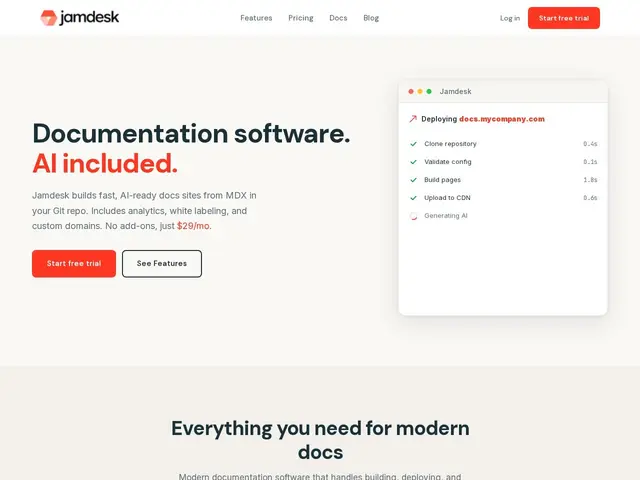
Description
If you've ever written documentation for a piece of software, you know the drill: you write it in Markdown, you build some kind of website out of it, and then a year later you find out ChatGPT is confidently making up wrong answers about your product because it never actually read your real docs. Jamdesk tries to close that gap. You write your pages in Markdown/MDX and keep them in a Git repository like any other code; Jamdesk turns that into a polished documentation website, but it also automatically exposes every page as raw, AI-readable text and runs a small "MCP server" — a kind of standard plug that lets tools like Claude, Cursor or ChatGPT connect straight to your docs instead of guessing.
Under the hood, Jamdesk supports MDX with about 25 interactive components (tabs, callouts, code blocks, collapsible file trees), auto-generates API reference pages from an OpenAPI spec, and deploys from a GitHub push in roughly a minute. It ships an in-site AI chat search box for readers, plus an analytics dashboard (traffic, geography) and white-label custom domains. Pricing is a 14-day free trial of the full Pro tier, then $29/month for one docs project (extra projects $15/month), with custom Enterprise pricing above that — positioning it as a smaller, developer-first alternative to established players like Mintlify, GitBook or ReadMe.
💬 Our review
The short version: Jamdesk is betting that "AI-readable by default" becomes table stakes for documentation tools, and it's arguably ahead of the curve there — the built-in MCP server and markdown-per-page endpoints aren't bolted on, they're the pitch. If your docs already live in Git as Markdown, migrating is low-friction and the deploy speed (about a minute from a GitHub push) is a real convenience.
The honest caveat: Mintlify, GitBook and ReadMe are much more established, have larger integration ecosystems, and are increasingly shipping their own AI-search and llms.txt-style features too, so Jamdesk's "AI-first" edge is a moving target rather than a permanent moat. At $29/month for a single project it's priced competitively against Mintlify's comparable tiers, but there's no visible free tier beyond the 14-day trial — worth confirming you actually need the AI-agent angle (versus just wanting solid docs hosting) before committing, since that's the entire reason to pick this over a more battle-tested competitor.
💰 Pricing
📊 Global score
🤖 AI-enriched data
Essai gratuit 14 jours (accès Pro complet) ; Pro 29$/mois par projet de docs (projet supplémentaire 15$/mois ou 150$/an) ; Enterprise sur devis
Pros
Serveur MCP intégré nativement, pas ajouté après coup
Déploiement en ~1 minute depuis GitHub
Génération auto de la référence API depuis un spec OpenAPI
Cons
Pas de palier gratuit permanent, seulement un essai de 14 jours
Concurrents (Mintlify, GitBook) bien plus établis et rattrapent déjà sur l'IA
Écosystème d'intégrations plus restreint qu'un acteur historique