Burnless
Keeps long AI agent sessions cheap by summarizing what happened into short notes instead of replaying the entire conversation history on every single turn.
🔗 Visit Burnless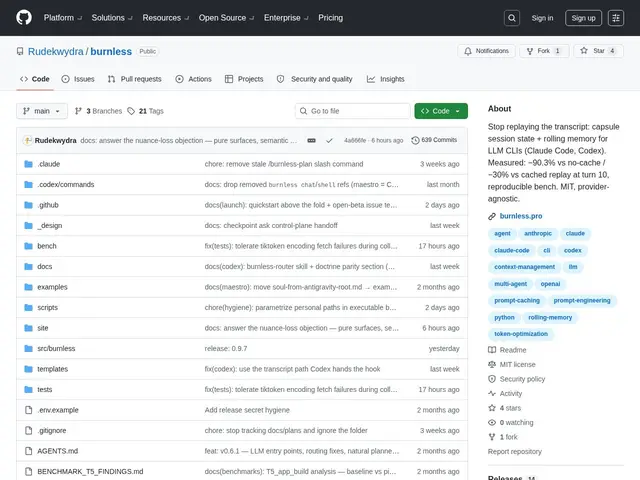
Description
A long-running AI agent session gets expensive fast, because most agent frameworks resend the entire conversation transcript with every new turn — by turn 50, you're paying to re-read 49 previous turns just to add one more. Burnless replaces that full replay with compact, disk-stored "capsules" — roughly 80-character summaries per turn — so the model only sees a condensed history instead of the whole thing.
It routes work across gold/silver/bronze model tiers depending on task difficulty, and runs a filesystem-first audit that verifies a worker's claimed output against the actual files it touched, rather than trusting the model's self-report. It's provider-agnostic, working with Claude, Codex, Gemini, and Ollama, and uses append-only sessions with bit-identical system prompts to preserve provider-side prompt caching. The architecture splits into three components: a Maestro orchestrator, Worker subprocesses, and the Capsule state store. The project reports a measured 90.3% cost reduction versus full transcript replay on a 23k-token system prefix, and Monte Carlo simulation showing up to 93.7% reduction. It's open source under the MIT license.
💬 Our review
The short version: if you run AI agents on long tasks and watch your token bill climb turn after turn, Burnless's core idea — summarize instead of replay — directly attacks the biggest cost driver in long agent sessions, and the reported 90%+ reduction, if it holds up in your own workload, is a substantial saving.
Against just letting your agent framework replay the full transcript every turn (the default in most setups), Burnless trades a small amount of context fidelity — summaries lose some detail versus the full transcript — for a large cost reduction, and the filesystem-first audit is a sensible check against an agent that claims success without actually doing the work. As a newer, single-maintainer open-source project, its cost-reduction numbers are self-reported rather than independently benchmarked, so it's worth validating on your own session lengths and providers before betting a production workflow on the savings holding at scale.
💰 Pricing
📊 Global score
🤖 AI-enriched data
Open source, licence MIT
Pros
Réduction de coût mesurée d'environ 90% vs replay complet
Audit filesystem-first qui vérifie le travail réel plutôt que la déclaration du modèle
Agnostique au fournisseur (Claude, Codex, Gemini, Ollama)
Cons
Chiffres de réduction auto-rapportés, pas de benchmark indépendant
Résumés en capsules perdent un peu de fidélité vs transcript complet
Projet récent, mainteneur unique visible