Trustero
Uses AI agents to handle the governance-risk-and-compliance busywork — reading your policies, checking your controls, filling out security questionnaires — that would otherwise eat up a compliance team's week.
🔗 Visit Trustero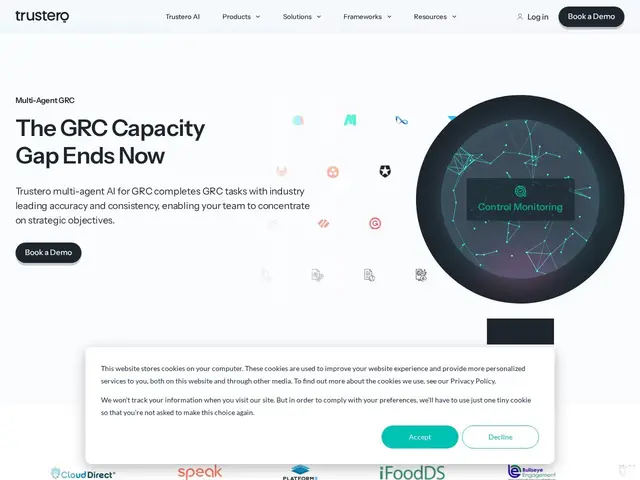
Description
Compliance and security questionnaires from customers, continuous control monitoring, and keeping policies aligned with frameworks like SOC 2 or FedRAMP are the kind of repetitive, detail-heavy work that GRC (governance, risk and compliance) teams spend enormous amounts of time on manually. Trustero leans specifically on AI agents to take that load off: it reads and assesses your policies and controls, continuously monitors whether they're still being followed, and can answer customer security questionnaires automatically by drawing on your existing compliance documentation.
Its feature set includes Evidence Management powered by AI agents, Continuous Control Monitoring, Policy and Control Assessment, Questionnaire Automation, a "Trustero Intelligence" AI Q&A assistant, customizable "TI Playbooks" for automating specific workflows, report and dashboard generation, integrations with other GRC and SaaS tools, and a customer-facing Trust Portal. It supports a notably wide range of frameworks — SOC 2, CMMC, FedRAMP, SOX, PCI and DORA — positioning it toward larger or more regulated organizations, including MSSPs managing compliance for multiple clients. Pricing is paid but not disclosed on the site.
💬 Our review
The short version: Trustero leans harder into "AI does the GRC work" than Secureframe or Thoropass, with its AI question-answering assistant and automated questionnaire responses as the headline feature rather than just evidence collection — worth a look specifically if questionnaire fatigue (answering the same customer security questionnaires over and over) is your actual pain point.
Its framework list (SOC 2, CMMC, FedRAMP, SOX, PCI, DORA) is broader and more enterprise/regulated-industry-leaning than the SOC-2-and-ISO-27001 focus of Secureframe or Thoropass, and the inclusion of MSSP support suggests it's also built to be used by firms managing compliance on behalf of several client companies at once — a different buyer than a single SaaS startup getting its first SOC 2. As with the rest of the category, pricing isn't published, so there's no way to say whether it's cheaper or pricier than Secureframe/Thoropass/Vanta without a quote; the practical filter is whether you need FedRAMP/DORA/SOX coverage (Trustero) versus a startup just needing SOC 2 fast (Secureframe, Vanta, Drata are more commonly used for that specific case).
💰 Pricing
📊 Global score
🤖 AI-enriched data
Payant, tarifs non publiés sur le site.
Pros
Couverture de frameworks large : SOC 2, CMMC, FedRAMP, SOX, PCI, DORA
Automatisation des questionnaires de sécurité clients par IA
Assistant IA (Trustero Intelligence) pour répondre aux questions de compliance
Support MSSP pour gérer la compliance de plusieurs clients
Cons
Tarifs non publiés
Positionnement plus entreprise/régulé, moins adapté à une petite startup pressée d'obtenir son premier SOC 2
Moins connu que Vanta, Drata ou Secureframe