Kong
One of the most widely used API gateways — the layer that sits in front of a company's APIs to route, secure, rate-limit and monitor traffic — now expanding into managing AI model traffic and token costs the same way.
🔗 Visit Kong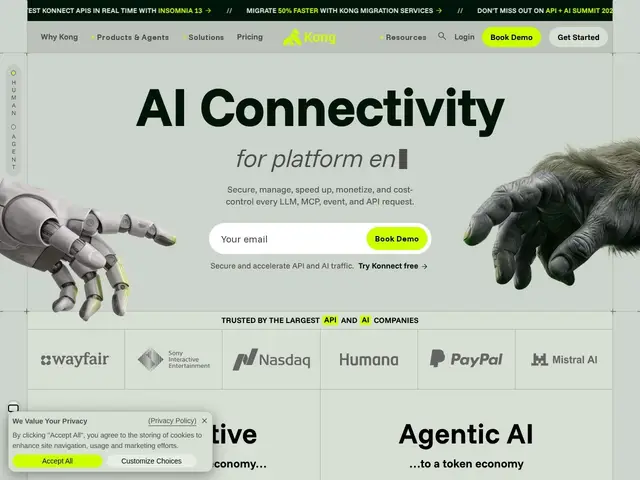
Description
Every company with more than a handful of APIs eventually needs something sitting in front of them to handle authentication, rate limiting, routing and logging, instead of building that logic into every single service — that's what an API gateway does, and Kong is one of the most established open-source options for it, now branching out to apply the same idea to AI: instead of every team calling OpenAI or Claude directly with no oversight, Kong's AI Gateway routes and meters those calls too.
The product line includes Kong Gateway (the free, open-source core), Kong Konnect (the managed cloud platform), an AI Gateway with token optimization and semantic caching to cut LLM costs, an Event Gateway, the Insomnia API client/testing tool, and a service mesh (Mesh). Features span the full API lifecycle: design, testing, publishing and monetization, a self-serve developer portal, real-time data-stream integration, and usage-based metering and billing. Kong for Startups offers up to $100k in credits and 50% off the AI Gateway for qualifying early-stage companies. Named competitors on the site include Apigee, AWS, IBM API Connect, MuleSoft and Postman.
💬 Our review
The short version: Kong is a safe, well-established default if you need a real API gateway (not just documentation) — the free open-source Gateway tier alone is enough for many teams, and the AI Gateway addition is a genuinely useful answer to "how do we stop every team from burning LLM budget with no visibility."
Against API Portal (also newly added to this catalog), the distinction matters: API Portal catalogs and documents APIs but doesn't touch live traffic, while Kong actually sits in the request path, enforcing security and rate limits — they solve different problems and could even be used together. Against Postman, which most developers already use informally for API testing and light documentation (free, Pro from $12/month), Kong operates one level up the stack as production infrastructure rather than a developer tool — not a real substitute for either. Kong's free OSS tier is the strongest reason to start there before evaluating Apigee or MuleSoft, both of which are typically priced and sold as bigger enterprise commitments with less community-driven flexibility.
💰 Pricing
📊 Global score
🤖 AI-enriched data
Kong Gateway open source gratuit ; Kong Konnect (cloud managé) tarifs non publiés ; Kong for Startups : jusqu'à 100k$ de crédits + 50% sur AI Gateway.
Pros
Tier open source gratuit et éprouvé (des années de production)
Couvre aussi le trafic IA/LLM (optimisation de tokens, cache sémantique)
Programme Kong for Startups avec crédits généreux
Écosystème complet : gateway, mesh, client API (Insomnia), event gateway
Cons
Tarifs Konnect (cloud) non publiés
Plus complexe à opérer qu'un simple outil de documentation d'API
Marché très concurrentiel face à des géants (AWS, Google, Salesforce)