API Portal
A centralized hub where a company's engineering team can catalog every API they run, publish interactive documentation for each one, and control who inside or outside the company gets access.
🔗 Visit API Portal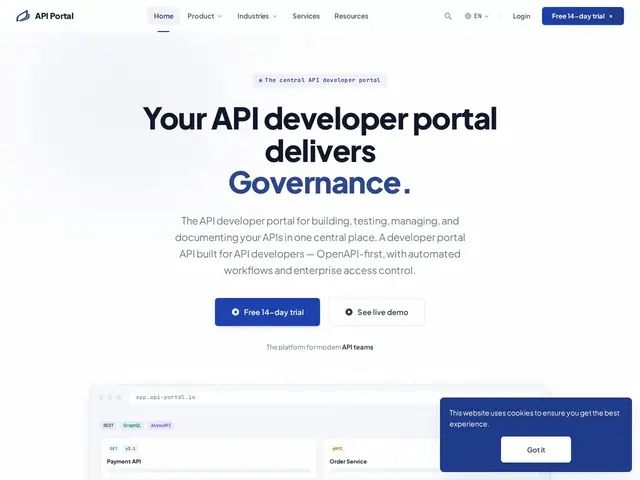
Description
Large companies often end up with dozens of internal APIs scattered across teams, each documented differently (or not at all), so developers waste time hunting for the right endpoint or re-building something that already exists. API Portal is meant to be the single place that lists every API a company has, lets anyone browse and try them from the browser, and enforces who's allowed to use what — essentially a phone book plus a testing ground for a company's internal and external APIs.
It supports OpenAPI, Swagger, AsyncAPI, GraphQL and RAML specs, offers interactive try-it-out documentation directly in the browser, version management with deprecation tracking, role-based access control and team management, and CI/CD pipeline integration for keeping docs in sync with code. It also lets teams convert their APIs into MCP servers so they can be called directly by AI assistants like Claude or ChatGPT. Pricing runs Starter (5 APIs, 3 team members) up to Enterprise (unlimited APIs, SSO/SAML, dedicated support), with exact numbers requiring a sales conversation.
💬 Our review
The short version: API Portal is aimed squarely at mid-size-to-large engineering orgs that already have API sprawl and need a single catalog — it's not really built for a solo developer or a small startup with two APIs.
Its closest comparison in this catalog is Kong, which is a full API gateway (it actually routes and secures traffic) rather than just a documentation/catalog layer — Kong is the bigger, more established platform with a free open-source tier, while API Portal focuses narrowly on discoverability and docs without traffic management. Against Postman (free, Pro from $12/month per user), which many teams already use for API documentation and testing informally, API Portal's pitch is governance at scale: RBAC, version deprecation tracking and CI/CD sync matter once you have 50+ APIs and multiple teams, but are overkill if you have five. Since pricing isn't public, get a quote and compare it against what you'd pay to keep using Postman's paid tier plus a wiki page before committing.
💰 Pricing
📊 Global score
🤖 AI-enriched data
Starter (5 APIs, 3 membres), Professional, Enterprise (illimité, SSO/SAML). Tarifs exacts sur devis.
Pros
Support OpenAPI, Swagger, AsyncAPI, GraphQL, RAML dans un seul outil
Documentation interactive testable directement dans le navigateur
RBAC et gestion d'équipe pour la gouvernance à grande échelle
Conversion d'APIs en serveurs MCP pour les assistants IA
Cons
Pas de tarif public, devis obligatoire
N'est pas un gateway (pas de routage/sécurisation du trafic comme Kong)
Overkill pour une petite équipe avec peu d'APIs