Aura
An open-source desktop IDE that structures AI coding into a visible plan-approve-review-validate loop, instead of an unchecked chat-based flow.
🔗 Visit Aura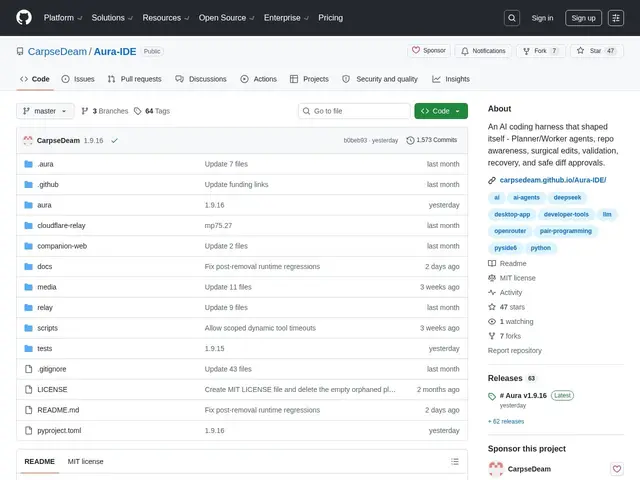
Description
When an AI coding agent works autonomously on a large task, it's easy to lose track of exactly what it changed and why, especially once you've approved a plan and it's off making edits across multiple files. Most chat-based coding tools show you a wall of text and a final diff, with no clear checkpoint where you can catch a bad direction before it compounds. Aura structures that whole process into a visible loop instead: it plans the work first and shows you the spec, waits for your approval before touching any files, shows every proposed change as a readable diff before it's applied, and runs project-appropriate validation checks afterward — so you always know what's about to happen and can stop it before code you didn't review ships.
Aura is a free, open-source desktop IDE built around a Planner/Worker architecture: a Planner agent inspects your codebase and writes a focused implementation spec, while a separate Worker agent executes it — reading files, applying edits, running commands. It includes repo-aware code intelligence with local BM25 search, automatic git backups, a 'WorkArtifact' projection so you can inspect exactly what happened after a run, scheduled recurring tasks ('Drones'), and a mobile companion app for remote monitoring. It supports multiple LLM providers including Claude, GPT, Gemini, DeepSeek and OpenRouter, and integrates with MCP for extended tool access.
💬 Our review
The short version: if you've been burned by an AI coding agent going off-script mid-task with no clear checkpoint to catch it, Aura's plan-approve-review-validate loop is a genuinely more controlled workflow than most chat-based agent tools, and it's free.
The honest comparison is against tools like Claude Code or Cursor, which are more mature and widely adopted — Aura's differentiator is making the approval/review structure explicit and visible rather than something you have to enforce yourself through careful prompting, which is valuable if you've been burned by an agent making sweeping unreviewed changes. At only 47 GitHub stars, it's early and small (built by essentially one developer, based on available signals), so expect rougher edges and slower community support than an established tool, even though the underlying design idea — separating planning from execution with a hard review gate — is sound. Worth trying on a side project to see if the workflow clicks for you before betting a production codebase on it; if you need broad ecosystem support and battle-tested reliability today, Cursor or Claude Code are the safer default.
💰 Pricing
📊 Global score
🤖 AI-enriched data
IDE desktop gratuit et open-source, apporte vos propres clés API (DeepSeek, OpenAI, Anthropic, Gemini, OpenRouter).
Pros
Boucle explicite Plan → Approbation → Revue → Validation
Architecture Planner/Worker avec un seul agent responsable de l'exécution
Sauvegardes git automatiques, diffs lisibles avant application
Compatible avec plusieurs fournisseurs LLM (Claude, GPT, Gemini, DeepSeek)
Cons
Projet très jeune et petit (47 étoiles GitHub)
Écosystème et support communautaire limités comparé à Cursor/Claude Code
Maturité en production encore à prouver