HyperDX
A free, open-source observability platform that unifies logs, metrics, traces, errors and session replays in one searchable interface — a self-hosted alternative to Datadog.
🔗 Visit HyperDX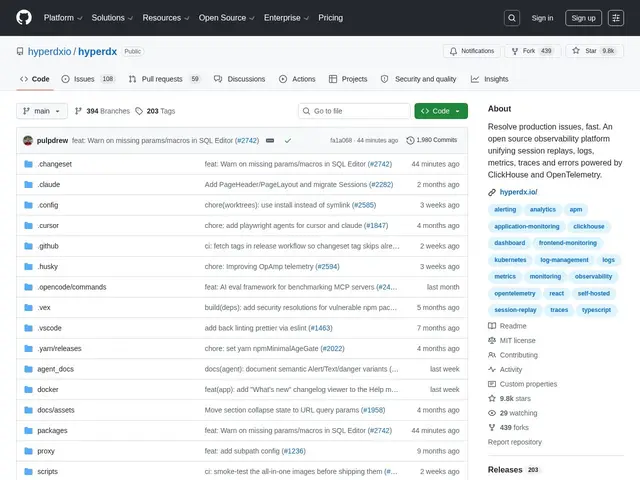
Description
When something breaks in production, the classic debugging nightmare is having your logs in one tool, your metrics in another, your traces in a third, and no easy way to jump between them to reconstruct what actually happened. Commercial platforms like Datadog solve this by unifying everything, but the pricing scales aggressively with data volume, which gets painful fast for a growing team. HyperDX is an open-source alternative that does the same job — pulling logs, metrics, traces, errors and session replays into one searchable interface — but you run it yourself, on your own infrastructure, for free.
HyperDX is built on ClickHouse (a fast, columnar analytical database) and OpenTelemetry (the open standard for collecting telemetry data), and is the core component of ClickStack, the open-source observability stack ClickHouse built after acquiring the HyperDX team. It supports Lucene-style and SQL queries, native JSON field querying, live-tailing logs and traces in real time, a visual chart builder that doesn't require writing SQL, and automated query optimization via materialized columns that HyperDX claims can be up to 10x faster than naive queries. It ships as a single Docker container (hyperdx-all-in-one) for quick self-hosted setup, with an optional managed ClickHouse Cloud backend if you'd rather not run the database yourself.
💬 Our review
The short version: if your team is already paying real money to Datadog or a similar platform for logs, metrics and traces, and you have the engineering capacity to self-host, HyperDX gets you most of the same unified-debugging experience for the cost of your own infrastructure instead of a per-GB bill.
The tradeoff against Datadog is the classic build-vs-buy one: Datadog's pricing scales painfully with data volume but requires zero ops effort, while HyperDX is free software but you own running ClickHouse and the collector pipeline yourself (though the all-in-one Docker image makes the initial setup fairly painless). Against other open-source options like Grafana + Loki + Tempo, HyperDX's pitch is a genuinely unified UI out of the box rather than stitching together three separate tools yourself, which is a real time-saver. Since ClickHouse acquired the HyperDX team, the project has institutional backing behind it rather than being a side project that might get abandoned — worth knowing if you're deciding whether to bet infrastructure on it long-term. Best fit for teams with some ClickHouse or self-hosting comfort already; if you want zero operational burden, a managed platform is still the simpler (if pricier) choice.
💰 Pricing
📊 Global score
🤖 AI-enriched data
Auto-hébergement gratuit (licence MIT), intégration optionnelle avec ClickHouse Cloud (payant) si on ne veut pas gérer la base soi-même.
Pros
Gratuit et open-source, licence MIT
UI unifiée logs/métriques/traces/replays dès l'installation
Image Docker tout-en-un pour un déploiement rapide
Adossé à ClickHouse après acquisition (pérennité)
Cons
Auto-hébergement nécessite de gérer ClickHouse soi-même
Moins mature que Datadog sur certaines fonctionnalités entreprise
Nécessite une familiarité avec l'écosystème ClickHouse pour en tirer le meilleur parti