Zaatar
A fleet of AI agents that handle the unglamorous, repetitive parts of SEO for you — drafting content, fixing schema markup, rebuilding internal links every day — by opening pull requests on your actual site's repo instead of hiding the work behind a dashb
🔗 Visit Zaatar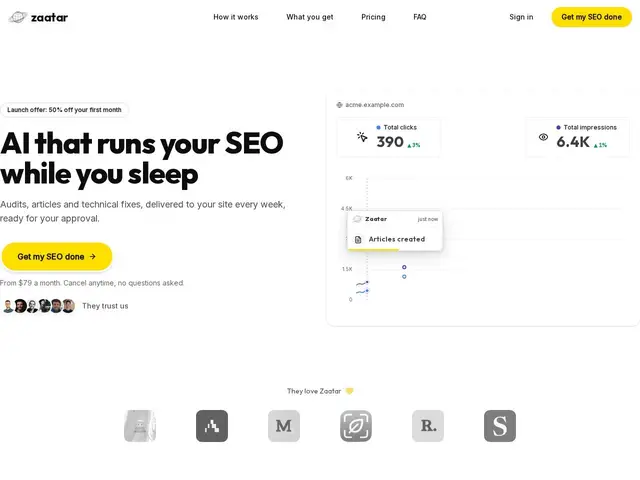
Description
SEO work is full of tasks that matter but rarely get done consistently: internal links that should point to a newer page but still point to an old one, structured data that's slightly wrong, content that needs a refresh nobody has time for. Zaatar's pitch is to hand that ongoing maintenance to a fleet of specialized AI agents rather than a single generalist tool, so each piece of the work gets consistent daily attention.
Zaatar's agents draft content automatically, patch structured data and schema markup, and rebuild a site's internal linking every day, with a human retaining approval over what actually ships. Its defining technical choice is being git-native: instead of a dashboard you log into and manually apply changes from, Zaatar opens pull requests directly on the site's repository, fitting into a workflow developers already use for reviewing any other code change. The site is early-stage — pricing isn't published, and it notably blocks generic automated fetchers (returning 403) while serving normal browser user-agents normally, confirmed live via direct testing with a browser user-agent.
💬 Our review
The short version: the git-native pull-request workflow is the smartest part of Zaatar's pitch — reviewing SEO changes the same way you'd review any other code change is a meaningfully better trust model than a black-box SEO dashboard — but with no public pricing and an early-stage feel, this is a bet on the team's execution more than an evaluated product yet.
Daily automated internal-link rebuilding and schema patching are real, tedious tasks that genuinely benefit from being handled continuously rather than in occasional manual sweeps, and keeping a human in the approval loop for content is the right call given how often fully-automated SEO content ends up generic or wrong. The lack of published pricing means you can't judge cost-effectiveness against a specialist tool like Surfer SEO or Clearscope without a sales conversation, and the site's own bot-blocking behavior (403 for generic fetchers) is a reminder that early-stage marketing sites of this kind are common in this space and worth verifying claims on directly rather than taking positioning copy at face value.
💰 Pricing
📊 Global score
🤖 AI-enriched data
Non publié sur la page d'accueil — produit en phase précoce, contact nécessaire pour la tarification.
Pros
Workflow git-natif : ouvre des pull requests plutôt qu'un dashboard opaque
Reconstruction quotidienne du maillage interne
Correction automatisée des données structurées/schema
Humain conserve le contrôle d'approbation stratégique sur le contenu
Cons
Aucune tarification publique — produit en phase précoce
Pas de recul indépendant sur la qualité réelle du contenu généré
Nécessite un site avec un repo/workflow git existant pour tirer parti du modèle PR