VernLLM
A tiny open-source library that wraps your LLM API calls with the reliability plumbing you'd otherwise have to write yourself — retries, timeouts, caching, circuit breaking — so a flaky provider response doesn't take down your app.
🔗 Visit VernLLM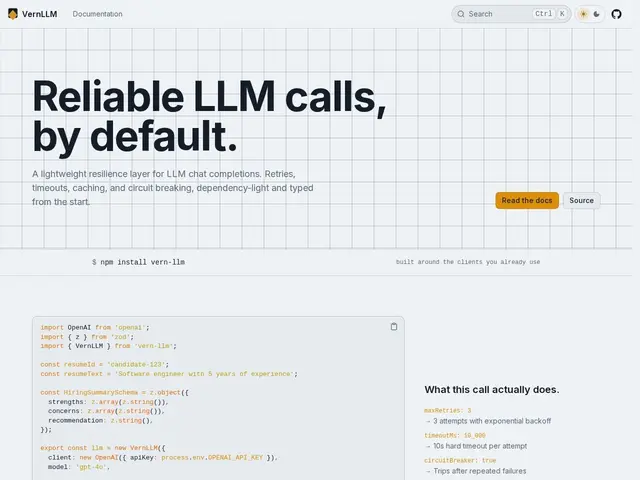
Description
Calling an LLM API in production runs into the same reliability problems as calling any external service: occasional timeouts, rate limits, transient failures, and responses that don't quite match the shape your code expects. Most teams end up writing ad-hoc retry loops and validation checks by hand for each provider; VernLLM packages that logic once so you don't have to rebuild it per project.
VernLLM is a free, open-source (MIT), TypeScript-only library that adds retry logic with exponential backoff and jitter, configurable per-attempt timeouts, circuit-breaker behavior, pluggable response caching, and structured output validation via Zod schemas on top of chat completion calls to OpenAI, Anthropic, Gemini, Bedrock, and other OpenAI-compatible providers. It also tracks token usage and supports pluggable logging, all in a genuinely lightweight package — 12.1 kB minified, 4.4 kB gzipped. It's distributed via npm as vern-llm, with source on GitHub, and is licensed for both personal and commercial use.
💬 Our review
The short version: if you're calling multiple LLM providers directly and have already written your own retry-and-timeout wrapper (or keep meaning to), VernLLM is a free, tiny library that does that job for you and is worth swapping in, since the switching cost is low and the bundle size is negligible.
The multi-provider support (OpenAI, Anthropic, Gemini, Bedrock, and OpenAI-compatible endpoints) matters if you route between providers or plan to migrate someday, since the resilience layer stays the same across all of them. Zod-based structured output validation is a genuinely useful addition beyond pure resilience — catching a malformed response before it breaks downstream code is as valuable as catching a network failure. The honest limitation is scope: this is a request-reliability wrapper, not a full LLM observability or orchestration platform, so if you need tracing, evals, or prompt management on top, you'll still need a separate tool alongside it — VernLLM solves specifically the retry/timeout/cache/validate problem, and solves it well for that narrow job.
💰 Pricing
📊 Global score
🤖 AI-enriched data
Projet open-source gratuit sous licence MIT, distribué via npm, utilisation personnelle et commerciale autorisée.
Pros
Gratuit et open-source, licence MIT
Support multi-fournisseurs (OpenAI, Anthropic, Gemini, Bedrock, compatibles OpenAI)
Validation de sortie structurée via schémas Zod
Bundle très léger (12,1 kB minifié, 4,4 kB gzippé)
Cons
Scope volontairement étroit — pas d'observabilité ou d'orchestration complète
Écosystème TypeScript uniquement, pas de version Python
Projet relativement jeune, à valider sur un usage de production réel