Inkspan
A single API that handles the whole messy world of PDFs for you — generating them, merging or splitting them, pulling structured data out of them, even translating them — so you don't have to stitch together five different libraries to do document work.
🔗 Visit Inkspan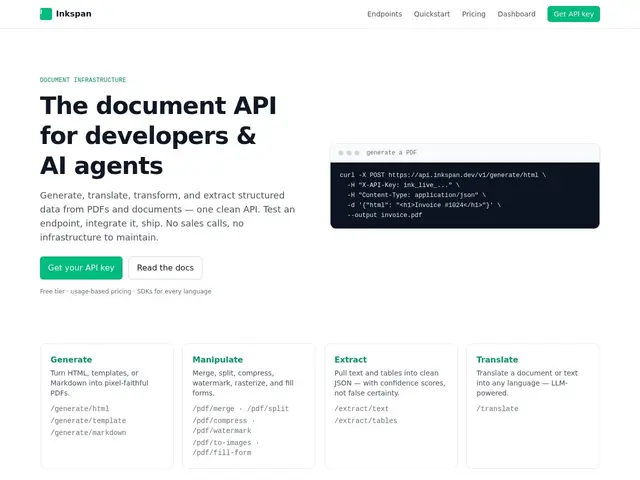
Description
Document handling is one of those tasks that looks simple until you actually try to build it: generating a clean PDF from a template, merging files, extracting a table into usable data, translating a contract — each of those is normally its own library, its own quirks, its own edge cases. Inkspan wraps all of it behind one RESTful API with a single API key, so a developer doesn't need to become an expert in five separate document tools.
Inkspan generates PDFs from HTML, templates, or Markdown, manipulates existing PDFs (merge, split, compress, watermark, convert to images, fill forms), extracts text and tables into JSON with confidence scores for OCR accuracy, and translates documents into any language using LLM technology. It's accessible via a simple X-API-Key-authenticated REST endpoint (api.inkspan.dev/v1/) with official SDKs for cURL, Python, and Node.js, and requires no infrastructure to maintain. The free tier covers 100 documents per month with no credit card required, with Starter, Pro, and Scale plans available for higher volume, though exact usage-based pricing for paid tiers isn't published on the homepage.
💬 Our review
The short version: if your product touches PDFs in more than one way — generating them and extracting data from them, say — Inkspan's appeal is consolidation: one API and one bill instead of stitching together a PDF library, an OCR service, and a translation API separately, and the 100 free documents a month with no credit card make it easy to test before committing.
The real value here is breadth: generation, manipulation, extraction with confidence scores, and LLM-based translation in a single interface is a genuinely convenient combination, and 'no infrastructure to maintain' is a fair selling point against the DIY approach of self-hosting multiple open-source PDF tools. The catch is that neither the paid-tier pricing details nor the underlying model quality for extraction/translation are transparent on the homepage, which makes it hard to judge cost or accuracy at scale before signing up — worth testing your specific document types against the free tier's 100-document allowance before assuming it'll hold up on messy real-world PDFs (scanned contracts, multi-column tables) at production volume.
💰 Pricing
📊 Global score
🤖 AI-enriched data
Gratuit jusqu'à 100 documents/mois (sans CB) ; plans Starter, Pro, Scale à tarification à l'usage non publiée.
Pros
Un seul API pour génération, manipulation, extraction et traduction de PDFs
100 documents/mois gratuits sans carte bancaire
Scores de confiance sur l'extraction OCR/texte
SDKs cURL, Python, Node.js — aucune infrastructure à gérer
Cons
Tarification des plans payants non détaillée sur le site
Qualité de l'OCR/traduction à valider sur des documents réels avant d'engager du volume
Marché concurrentiel avec des acteurs établis par segment (PDF.co, DeepL)