Rivora
An open-source 'engineering memory' tool that pulls together GitHub, CI logs, Kubernetes, and Sentry into one place, so a team investigating an incident isn't stuck re-piecing together the same story from five different dashboards every time.
🔗 Visit Rivora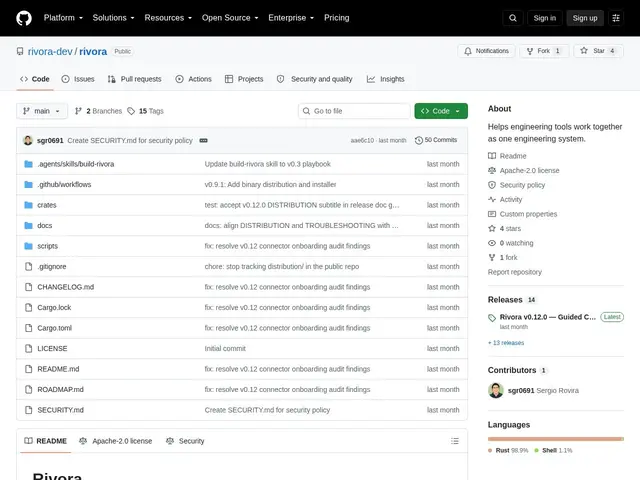
Description
When something breaks in production, the frustrating part is rarely the fix itself — it's the twenty minutes spent jumping between GitHub, CI logs, Kubernetes, and an error tracker just to reconstruct what happened. Rivora tries to remove that scavenger hunt by building a durable, searchable record of what your systems have already told you, so the next investigation starts from evidence instead of from zero.
Rivora is an open-source (Apache-2.0) memory layer and unified workspace written in Rust, currently at v0.12.0. It connects to GitHub, CI/CD, Kubernetes, and Sentry through guided connector onboarding, collects observations from each, and lets a team create 'investigations' that evaluate evidence, verify conclusions, and generate improvement proposals as controlled, reviewable plans. Its stated philosophy — 'runtime is the source of truth; conversation is an interface over typed engineering objects' — means the tool is built around structured, persistent engineering data rather than ephemeral chat logs. It ships as a CLI installable via curl on macOS and Linux, with secure local credential storage for each connector.
💬 Our review
The short version: Rivora is an interesting idea — a shared, structured memory of what your CI/CD and observability tools already know — but with 1 GitHub star and no visible production usage yet, it's a bet on a very young project, not a proven investigation tool.
The design is sound: rather than another chat wrapper around your logs, Rivora persists typed engineering objects (observations, investigations, evidence) so knowledge survives past a single Slack thread. Being open-source and Rust-based also means it's auditable and reasonably light to self-host. But this is pre-community software — no case studies, no adoption signal, and a connector list (GitHub, CI, Kubernetes, Sentry) that's a fraction of what an established platform covers. If your team already relies on a mature incident/observability stack, there's little reason to switch yet; if you're experimenting with how to give an AI coding agent durable context about your systems, it's worth a look specifically because it's free and self-hostable.
💰 Pricing
📊 Global score
🤖 AI-enriched data
Projet open-source gratuit sous licence Apache-2.0, aucune offre commerciale.
Pros
Open-source, licence Apache-2.0, auditable et self-hostable
Écrit en Rust, CLI léger installable en une commande
Philosophie de mémoire persistante et typée plutôt que chat éphémère
Connecte GitHub, CI/CD, Kubernetes et Sentry pour des investigations centralisées
Cons
Projet très jeune, seulement 1 star GitHub, pas de traction visible
Peu de connecteurs comparé aux plateformes établies (Backstage, Cortex)
Aucune référence client ou étude de cas publique à ce jour