uvr
A very fast package manager for the R programming language — the same idea as Python's popular 'uv' tool, but for R — that installs your project's packages in seconds instead of minutes, with a clean isolated environment per project.
🔗 Visit uvr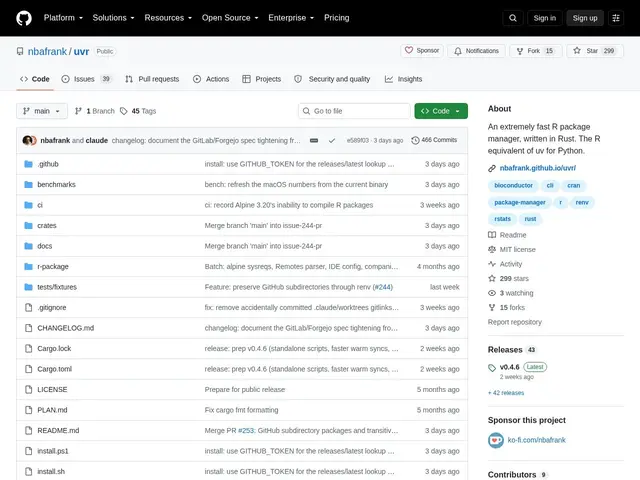
Description
Anyone who's used R for data analysis knows the ritual of waiting for install.packages() to compile things, sometimes for many minutes, every time a project needs its dependencies set up. uvr exists to remove that wait: it's the R-language counterpart to uv, the tool that made Python package installs dramatically faster by rewriting the slow parts in a fast systems language instead of accepting the old tooling's pace as normal.
Written in Rust and MIT-licensed, uvr uses a single declarative manifest (uvr.toml) and lockfile (uvr.lock) per project, giving each project its own isolated package library (.uvr/library/) instead of a shared global one that different projects can conflict over. It also manages R versions directly, without needing admin privileges, and installs pre-built binary packages via the Posit Package Manager (P3M) on macOS and Windows, pulling from CRAN, Bioconductor, and GitHub sources. It ships as a standalone binary needing no separate R or Python install, with a CI-friendly frozen lockfile mode and commands (init, add, sync, run, r install/use/pin, lock) that will feel familiar to anyone who has used uv, npm, or cargo.
💬 Our review
The short version: if you write R and have ever been annoyed at how slow package installation is, uvr's benchmark numbers are compelling enough to justify trying it on a real project — a full tidyverse install in 0.27 seconds versus 0.82 seconds for renv and 11.78 seconds for base install.packages() is not a marginal improvement.
The design choices are sound and clearly borrowed from what already worked in the Python ecosystem: per-project isolation, a lockfile for reproducibility, binary packages instead of compiling from source where possible, and R version management without needing sudo. Being free, open-source, and a single standalone binary means there's essentially no cost to trying it on one project before committing further. The main open question is ecosystem maturity — renv is the long-established, officially blessed choice in the R world with a bigger track record, so teams with strict reproducibility requirements or complex existing renv setups should weigh switching costs against the speed gain, especially since uvr is a newer, less battle-tested tool by comparison.
💰 Pricing
📊 Global score
🤖 AI-enriched data
Projet open-source gratuit sous licence MIT, aucune offre commerciale.
Pros
Performance nettement supérieure : 0,27s vs 0,82s (renv) vs 11,78s (install.packages)
Environnements isolés par projet avec manifeste et lockfile déclaratifs
Gestion des versions R sans droits administrateur
Binaire autonome, aucune dépendance R ou Python préalable requise
Cons
Écosystème plus jeune et moins éprouvé que renv
Moins de documentation communautaire et de cas d'usage publiés
Migration depuis un setup renv existant à évaluer au cas par cas