OpenParser
An open-source toolkit that turns messy PDFs and images into clean, structured text and data — with SDKs for TypeScript and Python plus a command-line tool, so you can drop it straight into a CI pipeline instead of relying on a closed, paid API.
🔗 Visit OpenParser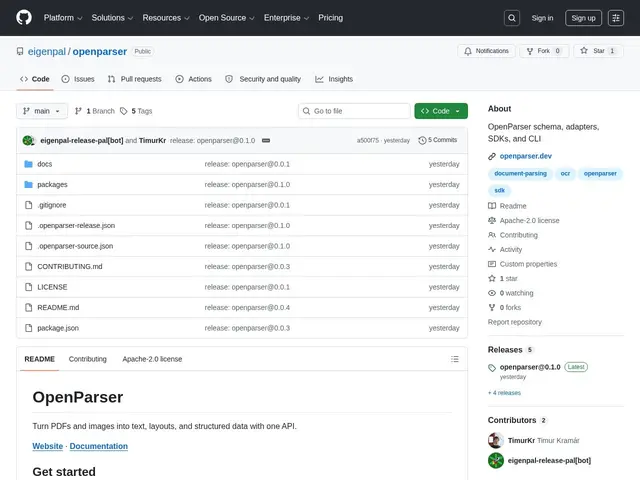
Description
Extracting usable text and structure out of a scanned PDF or an image of a document is a problem nearly every data pipeline hits eventually, and most solutions to it are proprietary APIs with per-page pricing. OpenParser takes the alternative route: an open-source, self-controllable document parser you can run as part of your own stack rather than sending documents to a third party.
OpenParser is Apache-2.0 licensed and parses PDFs and images using OCR (PaddleOCR-VL-1.6) alongside layout and structured-data extraction, exposed through TypeScript and Python SDKs plus a CLI built for terminal and CI/CD use. It handles runtime validation and schema generation, converts provider responses through adapters, and includes synchronous parsing operations behind a web-based authentication system. The project is genuinely early — around 5 commits at the time of research — and is distributed as several packages (@openparser/sdk, openparser-sdk, @openparser/cli, @openparser/schema, @openparser/adapters), built using the Bun package manager.
💬 Our review
The short version: OpenParser is a promising open-source alternative to paid document-parsing APIs, and being free with Apache-2.0 licensing means there's no cost or lock-in risk in evaluating it — but at roughly 5 commits, this is pre-alpha software, not something to point at a production pipeline yet.
The multi-package structure (separate SDK, CLI, schema, and adapters packages) suggests a deliberate, modular architecture rather than a quick script, and the CLI's CI/CD focus signals the author is thinking about real automated-pipeline use cases from the start. The trade-off for adopting something this early is the usual one for pre-alpha open-source: no track record on OCR accuracy across document types, a small commit history that hasn't yet weathered many real-world edge cases, and API surfaces (SDKs, CLI, schema format) that may still change between versions. Compared to established paid document-parsing APIs, OpenParser trades reliability and support for being free, inspectable, and free of per-page billing — a reasonable trade for a side project or internal tool, riskier for something customer-facing today.
💰 Pricing
📊 Global score
🤖 AI-enriched data
Projet open-source gratuit sous licence Apache-2.0, aucune offre commerciale.
Pros
Gratuit et open-source, licence Apache-2.0
SDKs TypeScript et Python plus CLI pensé pour CI/CD
Architecture modulaire (SDK, CLI, schema, adapters séparés)
Pas de facturation à la page, contrairement aux API tierces payantes
Cons
Projet très jeune (~5 commits), stade pre-alpha
Aucun recul sur la précision OCR selon les types de documents
Surface d'API (SDK, CLI, schema) susceptible d'évoluer entre versions