SITREP
A desktop app that watches your screen during a production incident and lets you ask it plain questions about what's happening — like a colleague who was staring at the dashboards the whole time and remembers everything.
🔗 Visit SITREP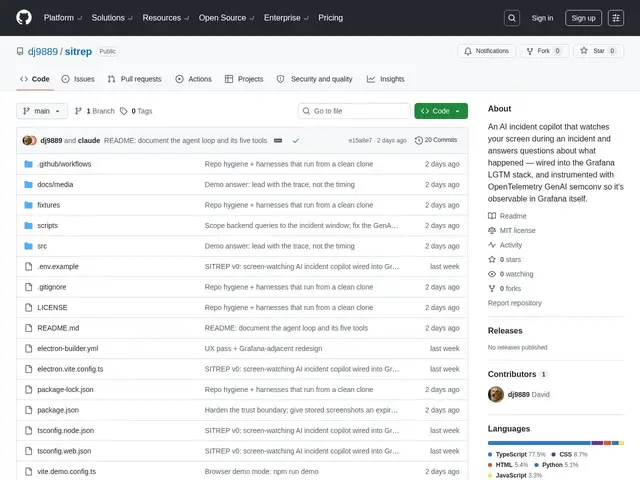
Description
During an incident, the hardest part is often just keeping track of what you've already seen — which dashboard showed the spike first, what the error rate looked like five minutes ago, whether that trace you glanced at ten minutes back is related. SITREP is built to be that memory: it watches your screen during an outage and lets you ask it questions afterward instead of you scrolling back through screenshots in your head.
SITREP is an open-source (MIT) Electron desktop app that captures screenshots roughly every 15 seconds during an incident, analyzes each frame with Claude's vision capabilities to produce structured observations, and builds a local, searchable timeline you can query. Its agentic chat has five tools available — timeline search, frame inspection, and querying Tempo traces and Prometheus metrics directly — so questions get answered by pulling real data, not just guessing from the screenshots. It includes tile-based change detection to avoid re-analyzing static screens (cutting token spend), a mock mode that works with no API key at all, an evidence overlay that shows exactly which screenshot (with bounding boxes) backs up an answer, per-incident spend ceilings, and a 'blackout mode' to pause capture during sensitive operations.
💬 Our review
The short version: SITREP is a smart, well-thought-out idea for a real problem — reconstructing what happened during an incident from your own screen instead of your memory — and being free, open-source, and mock-mode-capable makes it easy to evaluate without committing to API spend upfront.
The engineering details suggest real care went into cost and safety: tile-based change detection to reduce token spend, explicit per-incident spend ceilings, round limits on the agentic loop, and a blackout mode to pause capture during sensitive moments are all things a team would only add after thinking hard about actually running this in production incidents. The evidence overlay (showing which exact screenshot backs an answer) is a good trust-building feature for something that's effectively summarizing your own incident back to you. The trade-offs are the obvious ones for a 0-star, very new open-source project: macOS/Electron only right now, requires a Claude API key for live mode (mock mode aside), and no visible adoption yet, so you're an early adopter rather than joining an established tool.
💰 Pricing
📊 Global score
🤖 AI-enriched data
Projet open-source gratuit sous licence MIT ; coûts d'API Claude à la charge de l'utilisateur en mode live (mode mock disponible sans clé API).
Pros
Gratuit et open-source, licence MIT
Mode mock complet sans clé API pour évaluer sans coût
Détection de changement par tuiles pour réduire la consommation de tokens
Overlay de preuve montrant la capture exacte derrière chaque réponse
Cons
Projet très récent, 0 star GitHub, aucune adoption visible
macOS/Electron uniquement pour l'instant
Nécessite une clé API Claude en mode live (coût variable selon l'incident)